In the first half of this year, enthusiasm for embodied AI sometimes bordered on frenzy.
We were more cautious. Robotics deserved long-term investment, but the distance between a demonstration, a model, an order and a working deployment remained substantial. That was also the concern behind my earlier essay, “When Everything Is Called a World Model”: as the claims grew bigger, it became easier to lose sight of what a company had actually achieved.
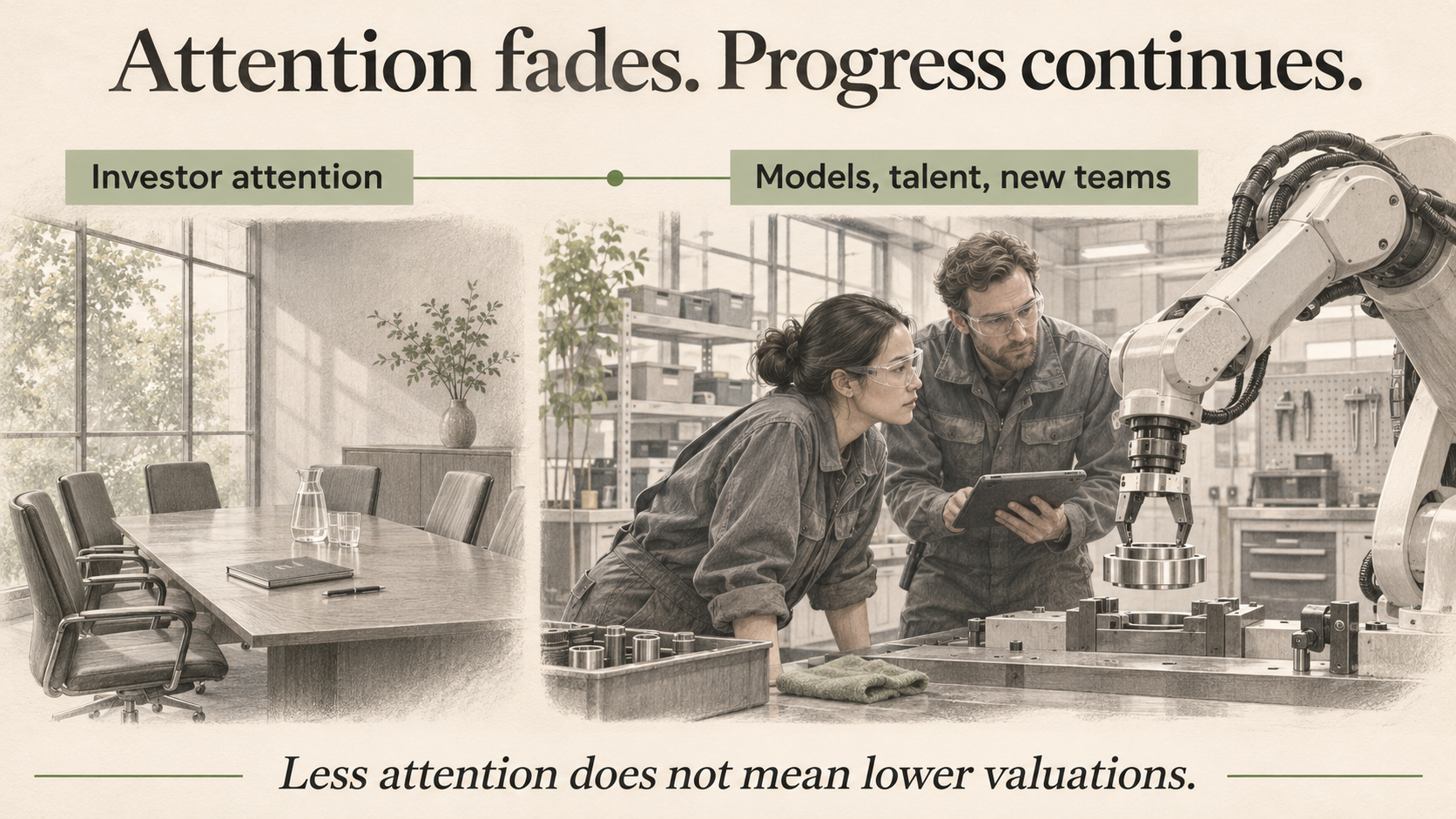
Lately, I have noticed a different pattern. Some investors have stopped looking at robotics deals, even as promising new teams continue to emerge.
The “fear” I see is a withdrawal of attention. Good companies are not necessarily cheap, and deal terms are not necessarily attractive.
Discovering an opportunity and deciding what to pay for it are separate jobs. While some investors step back, foundation models are improving and experienced model builders are moving into robotics. The conditions for starting a company may be getting better.
That brings me back to a familiar principle: fearful when others are greedy, greedy when others are fearful.
Models such as Astra pose a serious question: as robots draw more of their intelligence from general-purpose models, what should independent robotics companies build themselves?
These models can make robotics products more viable while eroding some companies' technical advantages. A better outlook for the industry does not make every company a better investment.
In my earlier essay on robotics' scaling moment, I described a cycle: better models open up applications, deployments produce real feedback, and that feedback supports further learning. General-purpose models could help more teams reach a minimum level of usefulness and enter that cycle sooner.
The change extends beyond understanding tasks and planning them. General-purpose models are beginning to generate actions. The boundary between high-level reasoning and motion control, often described as the “brain” and the “motor system,” will keep shifting. Control matters enormously today; that does not make it territory that general-purpose models can never enter.
I now see a greater chance that, over the next year or two, robots will make a larger-than-expected leap in learning tasks and adapting to new environments. A few demonstrations, task instructions and combinations of existing skills may replace some task-by-task training and tuning.
Learning a task, however, is different from delivering it reliably. Cycle times, recovery from failure, maintenance and cost still matter. A “GPT moment” might describe a breakthrough in learning. It is not a countdown to commercial viability.
New teams can design around stronger models from day one, concentrating their resources on physical problems that remain unsolved. Their competitors can use the same models. As the shared foundation improves, the question becomes: what does the company accumulate that others cannot easily copy?
Talent is another reason to pay attention. Among the new teams I encounter, more people with foundation-model experience are entering embodied AI. They bring knowledge of data mixtures, training systems and evaluation, along with judgment about where the next improvement is likely to come from.
When a robot understands a task but executes it poorly, should the team collect more demonstrations, change a sensor or revise its training method? The answer determines where the next dollar goes. Model researchers, controls specialists and hardware engineers need to work on the same problem. A distinguished résumé is a starting point; the founder's job is to turn those backgrounds into a team that learns.
Sequoia Capital partner Sonya Huang put it this way:
I actually think the application companies are the newest neolabs.
That echoes how we have thought about investing in AI applications. A durable application company earns a place in its market, gathers feedback and develops the ability to improve its models and products.
In embodied AI, I look for three capabilities in the same company.
First, a feedback loop in a valuable application. Can a failed grasp or a human intervention produce an improvement that can be reused? Recording logs is only the beginning. The team must know what information is missing, how to train on it and how to test whether performance has improved.
Second, strong control and hardware capabilities. Slippage during contact and deviations after a collision need rapid responses. Yet today's speed or cost advantage must become accumulated data, skills and engineering know-how if it is to endure.
Third, the ability to connect planning, execution, feedback and learning. A company need not build every general-purpose model itself. It does need to understand models well enough to use post-training, optimize policies and, where necessary, train specialized models so that field experience changes how the system performs.
Technical progress should make new problems easier to solve, not merely add to the list of projects completed.
Does the next customer require less tuning? Does a new object require fewer demonstrations? As deployments grow, does the engineering team become more productive—or simply busier? These questions reveal more than accumulated operating hours.
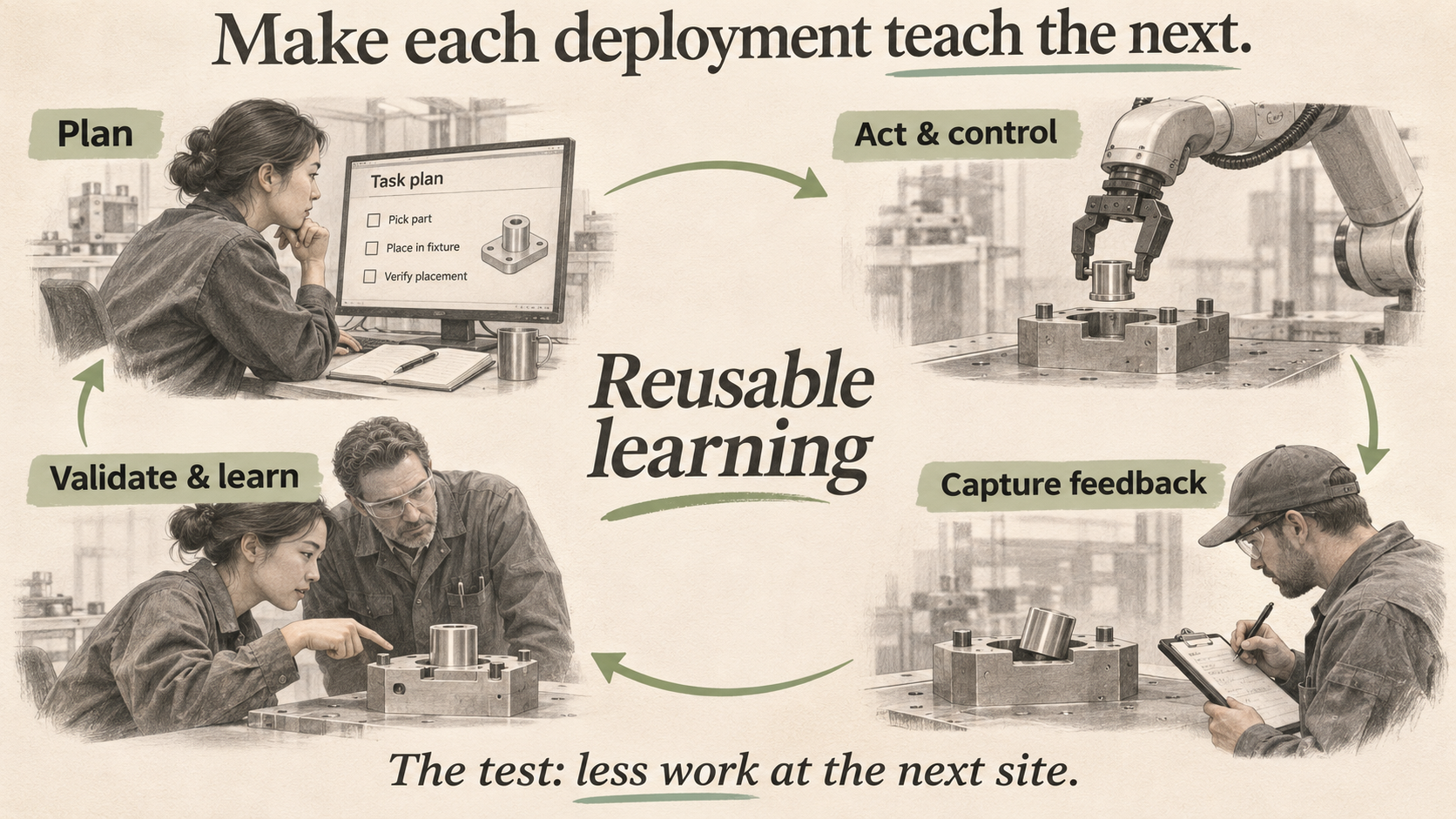
Models can also help analyze failures, revise skill programs, generate simulation tasks and test improvements. But correcting an action, expanding a tool library, updating model weights and improving the learning process itself are different achievements. Recursive self-improvement, or RSI, requires more than running another iteration. I want to know whether improvements persist, transfer and reduce the cost of the next round of learning.
Simulation requires similar discipline. Looking realistic does not mean accurately modeling contact, friction or deformation. Knowing what can be learned in simulation and what must be tested on hardware is itself a valuable capability.
Eventually, the economics have to work. After human intervention, repairs, downtime and depreciation, will the customer still pay—and can the company earn a reasonable margin? Customers buy completed work, not an impressive movement.
For Chinese companies, advantages built in the physical world may become more strategically important.
Leading US labs' current advantage at the frontier of general-purpose digital intelligence makes it harder to build a durable position on a temporary difference in model capability. Models can be distributed rapidly through software. Knowledge of industrial processes, equipment, deployment and maintenance has to be earned in the field.
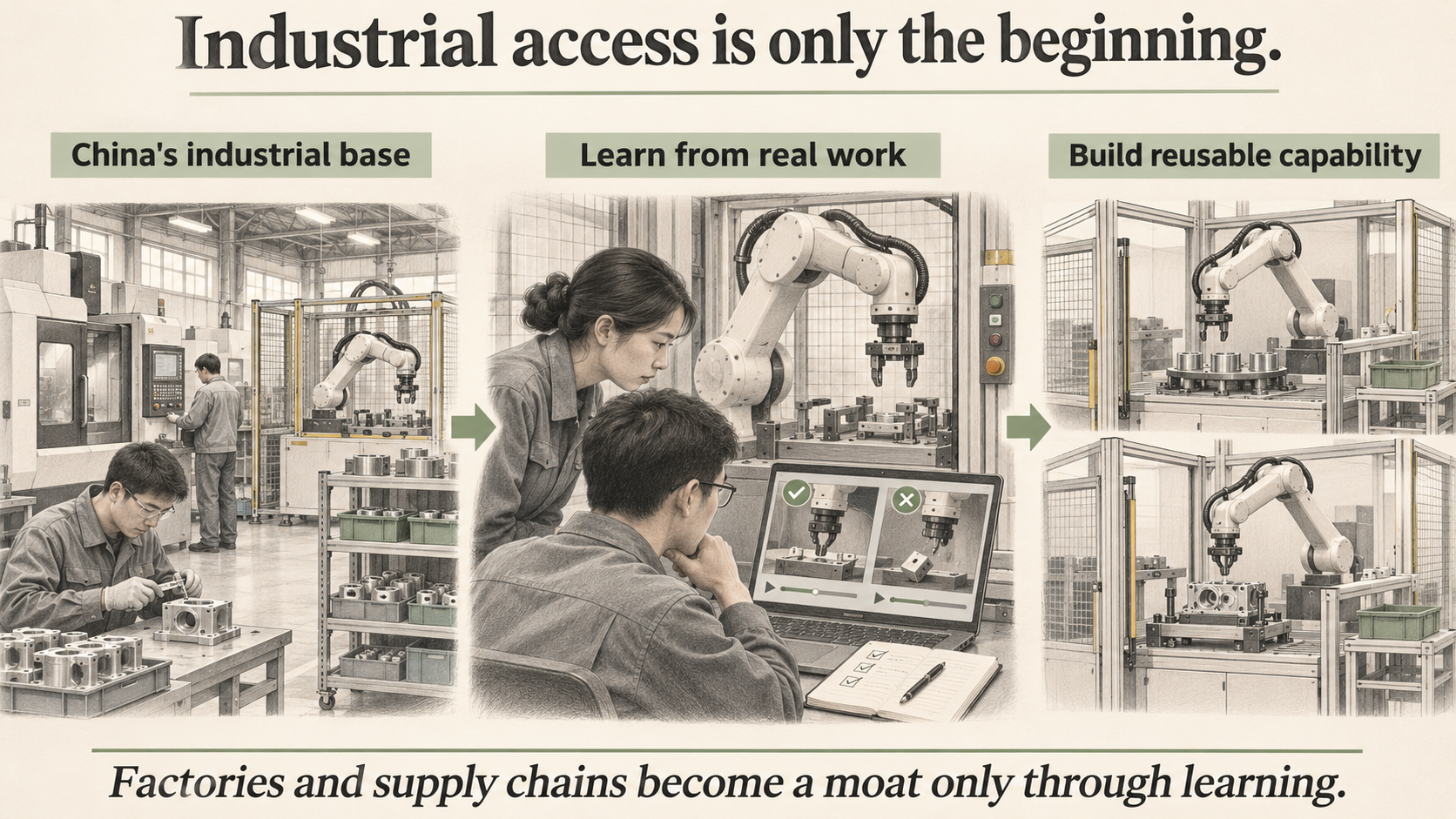
China's manufacturing base, interconnected supply chains and range of production environments offer favorable conditions. Proximity to customers, suppliers and real equipment can accelerate hardware and software iteration and yield interaction data that is difficult to obtain from public sources. As general-purpose intelligence improves, the ability to turn it into a reliable physical product can become more valuable.
Those industrial strengths do not automatically become a company's moat. The company must secure rights to use the data and turn field experience into reusable models, skills and engineering capabilities. The next deployment should get easier.
Sometimes a physical market is hard to enter simply because it is expensive. A business that requires extensive customization and ongoing on-site engineering support at every site may have costs rather than defensibility. I am interested in companies that turn the expense of working in the field into a cumulative learning advantage.
US–China competition, continuity of model access and local deployment requirements also make a case for China having an intelligence foundation it can independently control and improve for robotics. That could come from foundation-model companies such as DeepSeek, Zhipu AI or Kimi, or from their partnerships with robotics teams.
I would not rule out one or two embodied AI companies growing into general-purpose model platforms. But a model that generalizes across robots and physical tasks is different from one spanning language, code and science. Moving toward that broader ambition requires exceptional talent density, substantial financing, a founder who can attract and lead strong technical people, distinctive data and sustained evidence of progress.
When I look at a robotics company today, I ask one more question: if the next general-purpose model is smarter, faster and cheaper, will the company deliver more useful work—or lose the reason customers buy from it?
Earlier this year, I was cautious because expectations had run ahead of evidence. I am more willing to look now because models and talent are changing what startups can do, while some investors have turned their attention elsewhere.
For me, being greedy when others are fearful begins with spending the time: watching how a new team handles a failure, delivers a task and makes the next deployment better.
The companies worth finding are those that turn better shared models into products, real deployments into learning, and learning into easier delivery. A retreat in attention is a good time to look for them.