For twenty years we’ve explained the internet with one phrase: the attention economy. Platforms fight for your dwell time, advertisers fight for your clicks, recommendation systems keep guessing what you’ll want to see next. The phrase isn’t wrong. But I’ve come to think it no longer explains what’s actually happening.
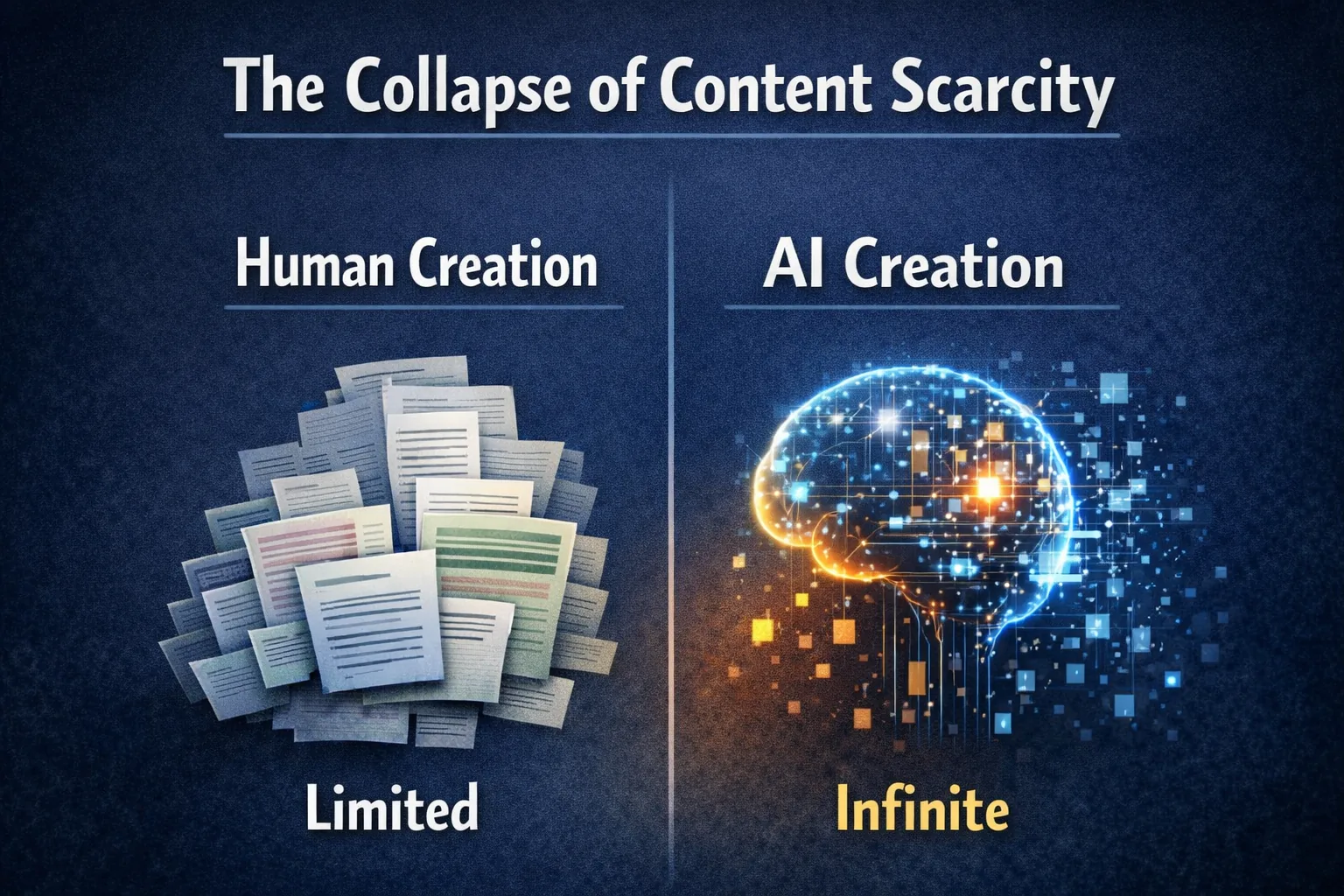
What generative AI actually breaks is not “human attention is finite.” It is a different premise, one we accepted for so long that we stopped noticing it: content costs something to make. Writing an article, shooting a video, making an image, writing a block of code — each used to require human time, experience and training. That constraint is now loosening fast.
Text, images, code, summaries, slide decks, scripts, and increasingly video keep getting easier to produce. And so a question surfaces that sits underneath “who can capture attention”:
When content stops being scarce, what becomes most expensive?
My answer: credibility.
AI won’t make the attention economy disappear. What it invalidates is the premise of content scarcity. When the supply of content swells toward infinity, the scarce thing shifts from “who can produce” to “who deserves to be believed.” That is what I mean by the credibility economy.
1. The Internet’s Hidden Equilibrium
We call the internet an attention economy, but pull it apart and the old internet actually rested on two scarcities at once. On one side, users had limited attention. On the other, high-quality content was limited too.
| Scarce resource | The problem it creates | The platform’s answer |
|---|---|---|
| Scarce attention | What users see | Search, recommendation, feeds |
| Scarce creation | Where content comes from | Creators, media, UGC, communities |
Search engines capture intent, social networks capture relationships, short-video platforms capture habits, subscriptions and communities capture long-horizon attention. Different forms, one shared premise: producing content still takes people, and a lot of human effort.
This is precisely what AI changes. It doesn’t hand anyone extra hours in the day, and it doesn’t make attention suddenly infinite. What it changes is the supply side of content. Once content can be generated at scale, at low cost, and without pause, the center of platform competition moves.
The old question was how to produce, attract and distribute more content. The new question will increasingly be which content deserves belief, which deserves to spread, and which you can act on. That isn’t a minor adjustment. It is a migration of scarcity across the digital economy.
2. “Being Able to Make It” Is Getting Cheap
Much of the premium on knowledge work used to come from scarcity of ability. Writing clearly, writing code, designing, distilling a complex problem, turning a vague idea into a plan — each had a barrier to entry, so the market paid for it.
AI is lowering those barriers. An ordinary student can generate a well-structured article in seconds. A junior engineer can ship working software with a model at their elbow. Someone who isn’t a designer can quickly produce a visual that looks credible. Even someone with little industry experience can have a model assemble an analysis that, on the surface, looks professional.
The point is not that human ability has vanished. It is that average-grade ability is being commoditized. When “being able to make it” is no longer scarce, the market stops paying a premium for ordinary output. Value migrates upstream: from execution to judgment, from generation to curation, from expression to accountability, and finally from content to credibility.
3. What the Quartz Crisis Teaches the AI Era
The story of Swiss mechanical watches is the right lens for this. When quartz arrived, the core function of a mechanical watch was hollowed out. If a watch exists only to tell time accurately, quartz is cheaper, more accurate and more reliable.
Mechanical watches did not disappear. They were forced to redefine what they were worth: no longer a timekeeping tool but craftsmanship, identity, aesthetics, history and symbolism. When a basic function is replaced by cheaper technology, value doesn’t evaporate. It moves to the layer above the function.
Knowledge work will go through the same process. As functional output gets cheap, the expensive things will be the ones that sit above function.
| Functional layer | After AI | The pricier layer above |
|---|---|---|
| Writing articles | A flood of drafts | Point of view, identity, credibility |
| Writing code | Faster implementation | Architecture, review, accountability |
| Design | More options | Taste, brand, trade-offs |
| Research | Easy summaries | Sources, judgment, quality of conclusions |
| Generating content | Falling cost | Who vouches, who is accountable, who is credible |
So AI doesn’t simply make people “unimportant.” It turns a slice of once-expensive capability into infrastructure, then pushes real value up the stack.
4. The Expensive Thing Won’t Be the Answer. It Will Be Who Stands Behind It.
AI will multiply answers, but more answers doesn’t make judgment easier. Often it’s the reverse: when ten plausible answers sit in front of you, the hard part has only just begun.
You need to know where the information came from, whether the conclusion has been verified, whether the person speaking has been right before, and who is on the hook if the judgment is wrong. In high-stakes domains — healthcare, finance, law, policy — you also have to bring in experts, audits, governance and compliance. Otherwise a smart-looking answer becomes a larger risk, not a smaller one.
That is the difference between a credibility economy and a plain content economy. The content economy asks whether more can be produced; the credibility economy asks whether it can be believed. The content economy rewards traffic; the credibility economy rewards being right over time. In the content economy, the better communicator wins. In the credibility economy, the more trustworthy one does.
5. Trust Is Civilization’s Real Infrastructure
Every expansion in the scale of human cooperation has run on a trust technology. Small communities ran on personal trust. Traditional states ran on religion, law and authority. The modern economy runs on banks, payment systems, central banks, credit ratings, audits and contracts.
None of these look like “technology products,” yet they are the real infrastructure beneath large-scale cooperation. The AI era opens a new gap in that infrastructure: when information can be generated without limit, how does a society decide what to believe?
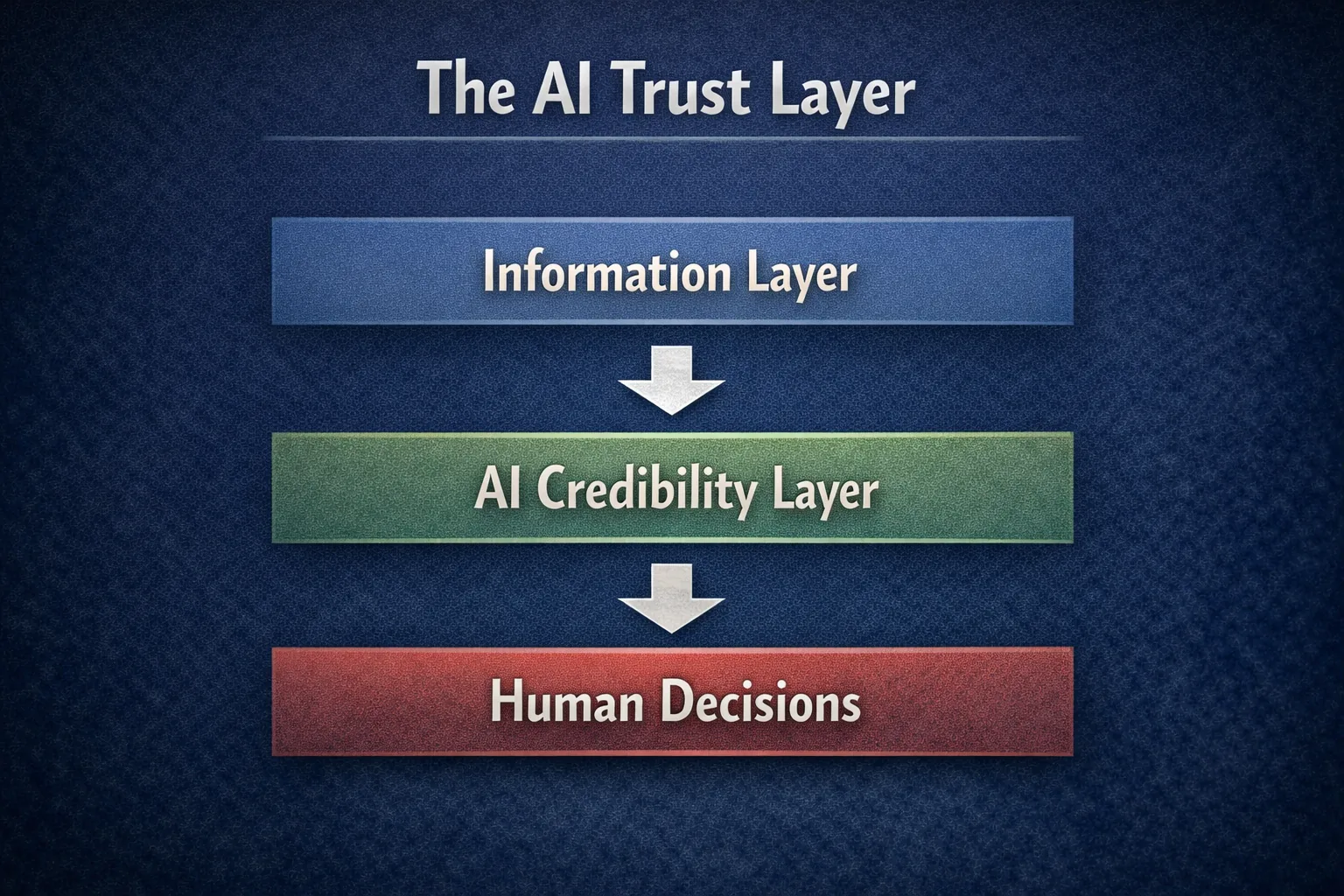
Bigger models alone won’t close that gap. It takes a three-layer system.
Layer 1: Technical Credibility
The technical layer answers one question: can this be tracked and verified? Provenance tracking, fact-checking, claim matching, historical accuracy, anomaly detection, model interpretability. Without this layer, credibility cannot scale.
Layer 2: Institutional Credibility
The institutional layer answers a different question: what happens when something goes wrong? Healthcare, finance, law and policy will not accept a black box with no process, no audit and no boundary of responsibility. They need standards, appeals, accountability, compliance and governance.
Layer 3: Network Credibility
The network layer answers the slowest question: how does trust accumulate over time? Expert participation, institutional endorsement, user feedback, reputation networks and track record gradually form a new credibility graph. Trust isn’t generated in one shot. It builds up through repeated use and repeated verification.
So the AI trust systems that matter most will probably not end up as ordinary software. They will look more and more like hybrid institutions: product and standard at once, platform and trust infrastructure at once.
6. The Core Formula of the Credibility Economy
If I had to compress it into one line:
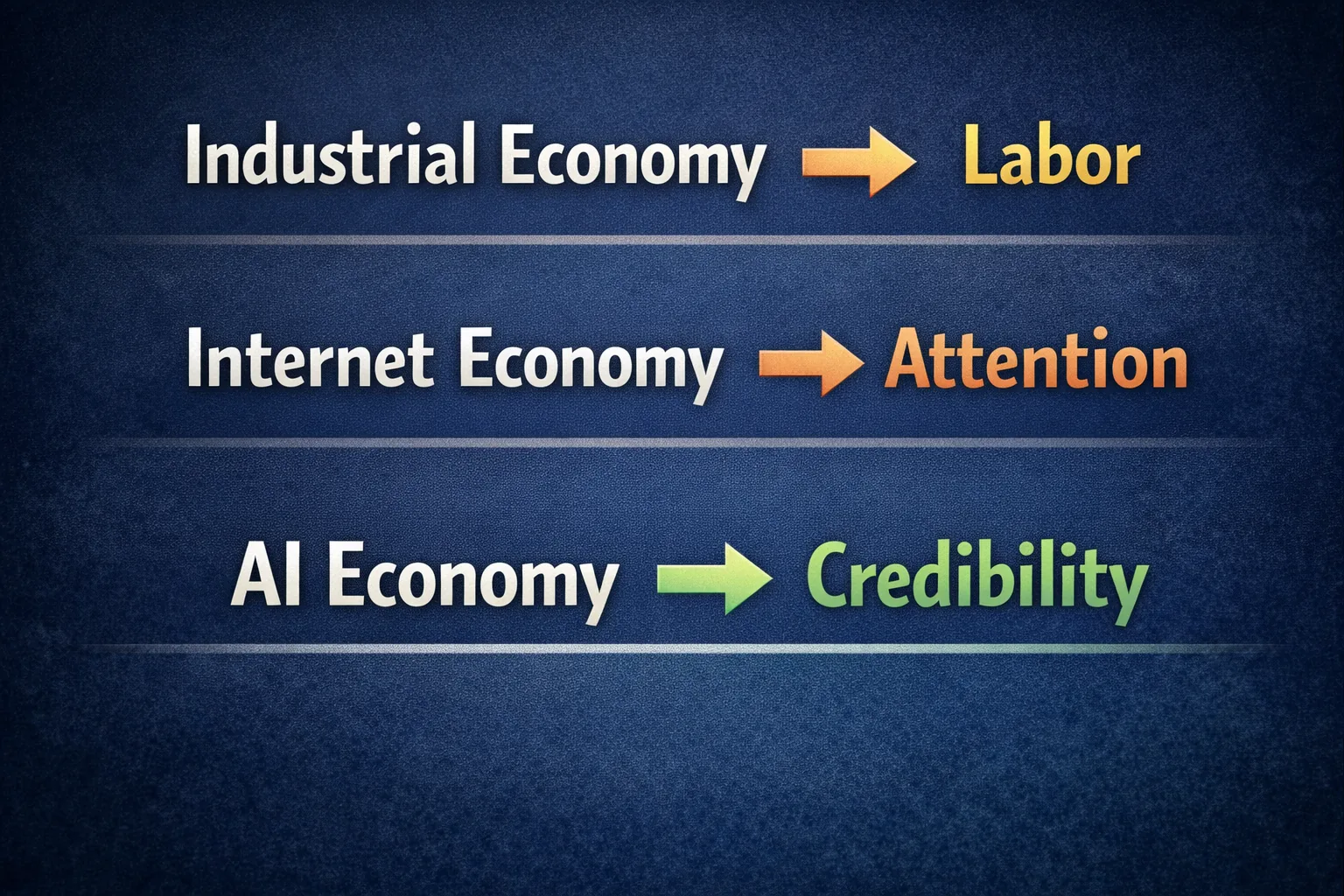
The industrial economy organizes labor.
The internet economy organizes attention.
The AI economy organizes credibility.
Attention won’t disappear, but it stops being the deepest bottleneck. In an environment flooded with content, the first thing you have to settle is not “what to see” but “what to believe.”
That reorders the value hierarchy across many industries. Distribution used to be what mattered most for a platform; now a platform also has to answer why it is qualified to distribute. Clicks used to be what mattered most for content; now content also has to answer why it deserves belief. Generation used to be what mattered most for an AI product; now an AI product also has to answer whether its output can be reviewed, traced and held accountable.
7. Five Signals Worth Watching
If this judgment holds, the next few years will bring some very concrete changes.
First, ordinary content keeps losing value. The average article, the average image, the average short video, the average summary will all keep getting cheaper. Content with no distribution, no identity and no trusted name behind it will get harder and harder to monetize.
Second, trusted curation gets expensive. Not every act of “organizing information” will be worth money. What will be worth money is organizing that carries sources, experts, judgment, a track record and a chain of accountability.
Third, high-stakes industries won’t go pure-software. Healthcare, finance, law and policy won’t simply adopt a chatbot. They will adopt AI wrapped in institutions — with process, with audit, with accountability, with governance.
Fourth, credibility graphs will emerge. There will be platforms that systematically record who said what, when they said it, whether it held up, who keeps getting verified and who keeps producing noise. A credibility graph of this kind may become a new piece of infrastructure for the AI era.
Fifth, governance becomes a product capability. Most people underestimate governance. In low-stakes content settings, model quality matters most. In high-stakes decisions, standards, appeals, audit, accountability and compliance are not a drag on innovation. They are the ticket that gets AI into the real world.
8. The Real Lesson for Founders and Investors
If you’re building an AI company, “I can generate more content” is no longer a pitch. The question that matters is whether you can become the credibility layer for a specific domain.
Concretely, five questions. Does your output have sources? Has your judgment been verified? Can your system be audited? Who is accountable when the result is wrong? Why would users keep trusting you over the long run?
Those five questions get closer to a moat than “is the model smarter?” ever will. Model capability diffuses, generation gets commoditized, workflows get copied. Long-term credibility, industry relationships, expert networks, audit mechanisms and accountability structures are very hard to copy overnight.
The most valuable AI companies of the next era won’t necessarily be the ones that “produce the most content.” They are more likely to be the ones that, in a domain where it matters, can answer a single question:
In a world of infinite noise, why should I trust you?
Coda: More Content, Pricier Trust
The most counterintuitive thing about the AI era is this. Content gets cheaper; credible content gets more expensive. Answers multiply; reliable answers grow scarce. Expression gets easier; judgment gets more valuable.
The real change is not “AI lets everyone produce content.” The real change is what follows: when everyone can produce content, who deserves to be believed?
That becomes the central question of the next decade, and the central question for the next generation of platforms, products, institutions and investment opportunities. AI won’t end the attention economy. It will end content scarcity, and carry us into a phase that is harsher — and worth more:
The credibility economy.