A universal framework for understanding intelligence across AI, history, and human systems
In 2017, a Google paper changed everything about AI. Its title was Attention Is All You Need.
Most people noticed the architecture. Few noticed the title.
Attention. The same word economists use to describe the scarcest resource in the digital economy. The same word neuroscientists use for the gateway to consciousness. The same word philosophers use for the first act through which a mind makes contact with the world.
One word. Four fields. The same thing.
That’s either a coincidence or a signal.
Here’s what I noticed after spending years thinking about AI: the technical vocabulary of machine learning keeps mapping, almost perfectly, onto concepts humanity already discovered in completely different domains.
Compression — the idea that intelligence is fundamentally about finding shorter descriptions of complex reality — was formalized by Claude Shannon in information theory. But Wittgenstein said the same thing about language. Plato said it about ideal forms. The neural network doing lossy compression of human knowledge is doing something those thinkers pointed at centuries ago.
Reinforcement learning — agents updating behavior based on reward signals from the environment — is mathematically identical to what Darwin described in biology and what Adam Smith described in markets. The equations are the same. The time scales are different. The substrate is different. The structure is not.
World models — internal simulations that let systems plan without real-world trial and error — are what Sun Tzu meant by “the general who wins makes calculations before the battle.” What Keynes meant by the beauty contest. What Soros meant by reflexivity. Different names, different centuries, the same cognitive architecture.
Emergence — capabilities appearing suddenly when scale crosses a threshold, impossible to predict from smaller systems — is exactly what historians describe when they talk about the birth of cities, the Industrial Revolution, the internet economy. The language is identical because the phenomenon is identical.
Alignment — ensuring a system optimizes for the real objective rather than a proxy — is what Jensen and Meckling called the principal-agent problem in 1976. It’s what every constitutional designer in history has wrestled with. The question of how you make powerful agents serve the intentions of those they represent is as old as power itself.
These mappings are too precise and too systematic to be coincidence.
They point toward something: AI is not inventing new problems. It is formalizing, in mathematics, the problems intelligence has always faced.
Which raises a question: if these concepts keep mapping onto each other across AI, economics, evolutionary biology, political philosophy, and history — what is the underlying structure they’re all pointing at?
I think there’s an answer. And once you see it, you can’t unsee it.
The question underneath all of them is this:
How does a finite agent act effectively in an infinitely complex environment?
This is the shared starting point of every theory of intelligence. Kant approached it from epistemology. Wiener from cybernetics. Shannon from information theory. Simon from organization theory. They arrived at different answers in different forms — but the skeleton of those answers is the same.
What AI has done, for the first time, is give us the mathematical language to assemble those scattered answers into a single coherent framework.
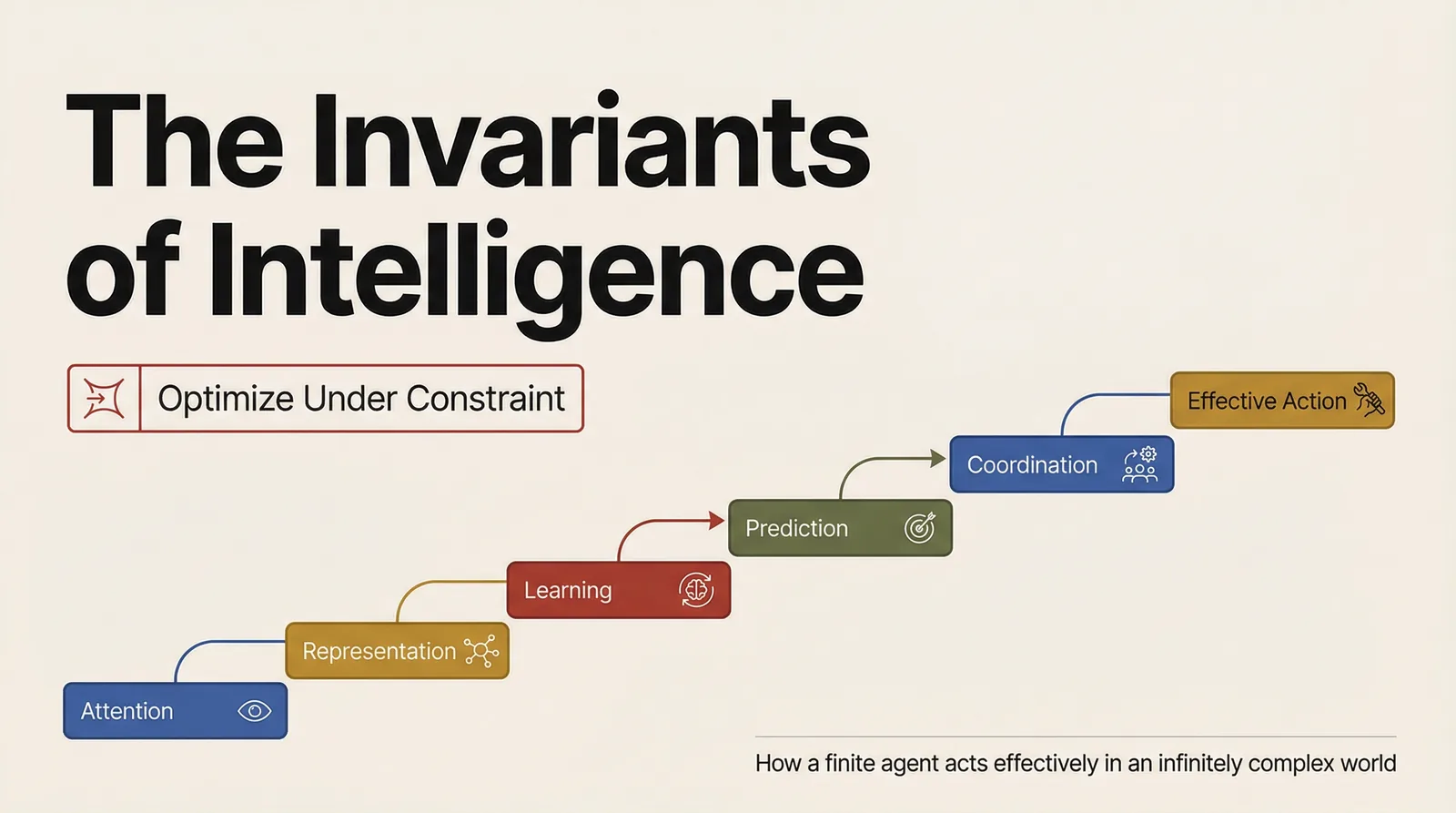
That framework has five layers. Not organized by discipline. Organized by the causal chain through which any finite agent — a neuron, a person, a company, a civilization, an AI system — contends with environmental complexity:
Attention — selecting what to perceive from an infinite stream. The gateway to everything.
Representation — compressing what you’ve attended to into an internal structure you can actually compute with.
Learning — updating that structure continuously, because reality changes and static representations decay.
Prediction — building a model of the future, because action happens then, not now.
Coordination — connecting with other agents when the problem exceeds what any single agent can handle alone.
Remove any one of these and the system fails at that layer. They’re not optional. They’re not specific to AI. They’re what any intelligent system does, at any scale, in any medium.
This is what I call the invariants of intelligence.
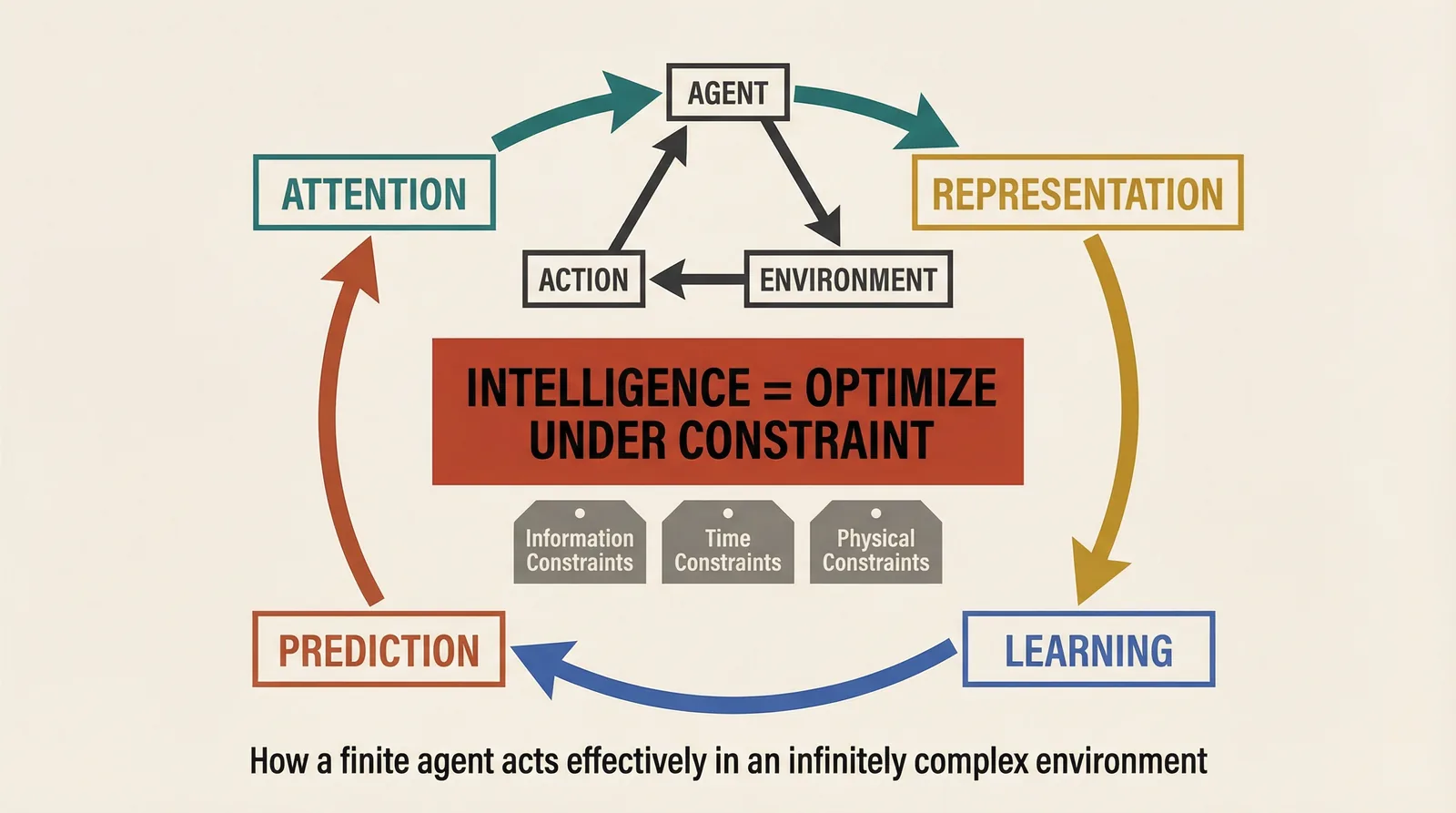
The Foundational Principle: Intelligence = Optimize Under Constraint
Before we go layer by layer, there’s a single mathematical idea that unifies all five.
Every intelligent system reduces to three elements: an agent (with a boundary, limitations, and internal state), an environment (everything outside that boundary — infinitely complex, continuously changing), and action (the agent’s intervention on the environment, which in turn changes the environment, which changes the agent).
Intelligence is the quality of the interface among these three. The better the interface, the more effectively the agent acts in more complex environments using fewer resources.
Express this in the most concise mathematical spirit: Intelligence = optimize under constraint.
Not metaphor. Literal mathematics.
Attention is maximizing relevance under the constraint of information entropy. Representation is minimizing reconstruction error under the constraint of bits. Learning is maximizing generalization under the constraint of sample size. Prediction is minimizing expected loss under the constraint of uncertainty. Coordination is maximizing collective utility under the constraint of individual rationality.
Five different optimization problems. Identical mathematical form.
Physics has the same structure in its deepest principle — the principle of least action: natural systems always evolve along the path of minimum action. Feynman path integrals, Snell’s law of light refraction, Hamiltonian mechanics — all elaborations of one idea. The five-layer framework is its counterpart in information processing.
The Three Levels of Constraint
Here’s something the standard AI discourse misses: the constraints aren’t just informational. They stack.
Physical constraints are the floor. The human brain consumes roughly 20 watts. Today’s largest AI training runs consume electricity equivalent to a mid-sized city. Silicon transistor density is approaching physical limits; quantum tunneling is beginning to disrupt circuit determinism. These constraints don’t disappear with better algorithms. They reappear in different forms.
Information constraints sit above physical ones. Shannon’s theorem gives the theoretical capacity ceiling for channels. Kolmogorov complexity gives the minimum description length for any object. Certain limits simply cannot be breached, regardless of hardware.
Time constraints are the final layer. Actions happen in the future; decisions must be made in the present. This is the fundamental reason the prediction layer exists.
The Conservation Law
Here’s the deepest implication of this structure: environmental complexity doesn’t disappear. It only transfers among the five layers.
The attention layer converts external informational complexity into attention cost. Representation converts that into computational cost. Learning converts present computation into future capability. Prediction converts capability into reduced decision cost. Coordination converts individual complexity ceilings into collective division of labor.
You can’t eliminate complexity. You can only move it somewhere more tractable.
The corollary for AI investment: optimizing one layer doesn’t reduce the system’s overall complexity — it shifts the bottleneck to the next layer. The enormous expansion of compute in recent years didn’t eliminate the challenges of intelligence. It shifted the bottleneck from “not enough compute” to “not enough data” to “not enough alignment” to “not enough coordination.” Bottlenecks circulate. They never disappear.
Reading the migration path of bottlenecks is reading the future of the AI industry.
Why These Five, and Not Others
The classification principle is singular: the causal chain of a finite agent contending with environmental complexity.
Environmental information must first be selectively received — without this, the agent is blind.
Received information must be converted into an operable internal structure — without this, it can’t be computed.
That structure must update to reflect changes in reality — without this, the agent operates on a stale map.
The updated structure must be used to infer the consequences of actions — without this, the agent can only react, never plan.
When a single agent’s capacity is exhausted, it must connect with other agents — without this, problems beyond individual capacity remain permanently unsolvable.
Remove any link: the chain breaks. Add any new link: it subsumes into one of these five.
One question always comes up: why isn’t action its own layer? Because action is the output of all five layers operating together — it’s embedded in every layer, not separate from them. Attending is itself an act. So is representing, learning, predicting, and coordinating.
Layer 1: Attention
The Scarcity Problem
The challenge: The world’s information is infinite. Processing capacity is not.
The optimization: Maximize relevance under the constraint of information entropy.
Start here, because this layer determines the quality of everything downstream. Wrong raw material in; precise error out — no matter how sophisticated the processing.
What the technology is actually doing
The Transformer’s Query-Key-Value mechanism, in plain language: compute how relevant each piece of information is to the current task, then allocate processing resources proportionally. High-relevance information gets more computation. Low-relevance information gets suppressed.
The profound part is the dynamism — relevance isn’t pre-fixed. It’s computed in real time from context. The same word, in different sentences, receives entirely different attention weights. This handles semantic ambiguity and context-dependence in ways earlier fixed-weight networks couldn’t touch.
Self-attention lets every position in a sequence directly “see” every other position — eliminating the RNN bottleneck where distant information had to travel through many sequential steps to influence anything. The Transformer’s revolution wasn’t making models larger. It was making information flow paths shorter.
Before attention can happen, though, the world must be cut into pieces — tokenization. The choice of where to make those cuts is, in a deep sense, a choice about what the system can think. GPT’s Byte Pair Encoding shapes the model’s implicit “view of language” — its capacity to handle multiple languages, rare words, code. The core challenge facing current multimodal models: what is the fundamental unit of meaning across text, image, audio, and video?
The economic logic
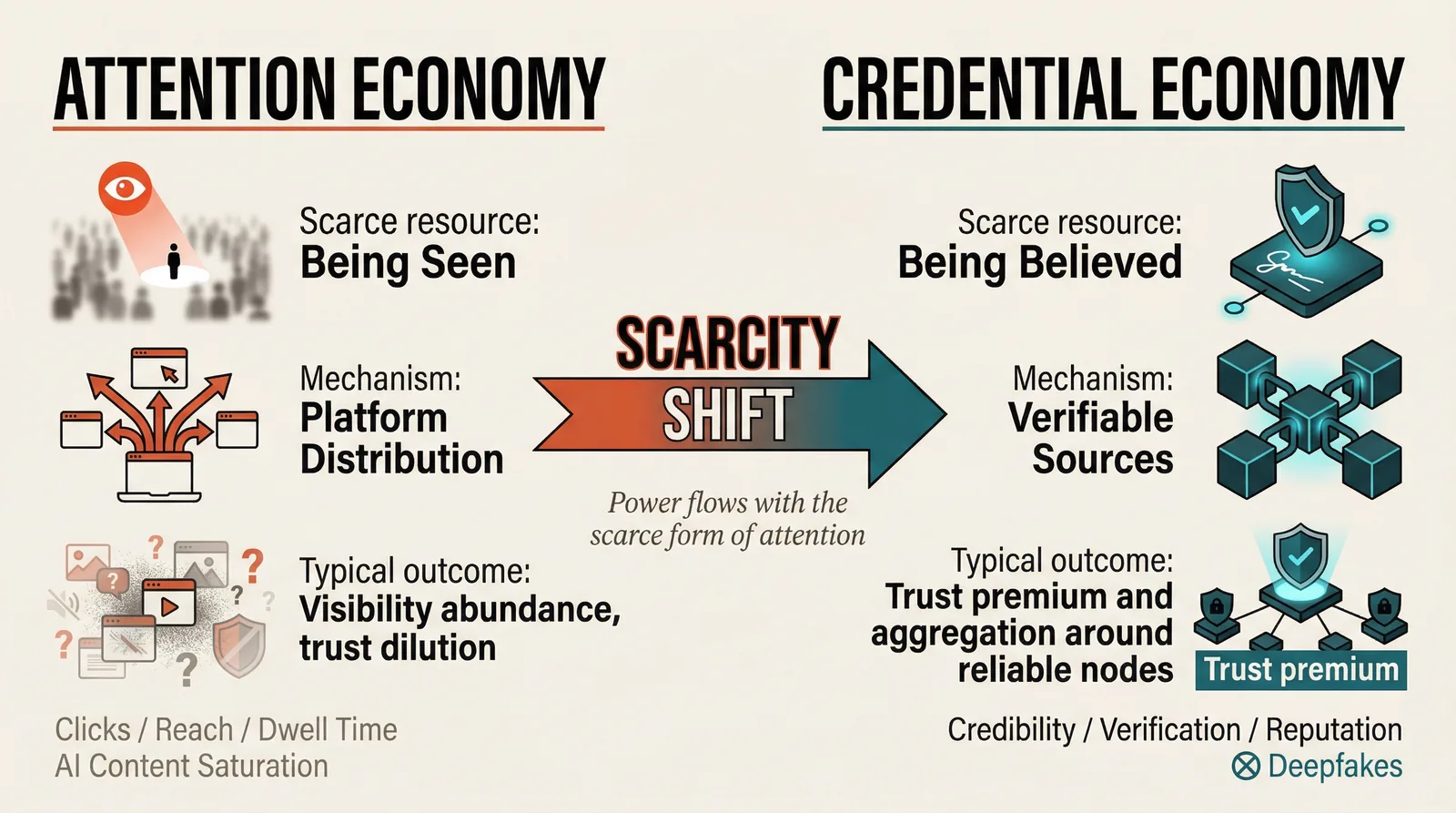
Herbert Simon predicted in 1971: “A wealth of information creates a poverty of attention.” He wrote this before the internet. He was describing today.
The attention economy’s logic: when goods are abundant, consumer attention is the scarce resource. Platform economics is, at its core, attention intermediation — exchanging free content for user attention, then selling that attention to advertisers.
But something is shifting. Attention can be captured at scale by algorithms. Credibility cannot be mass-produced. When anyone can use AI to generate professionally-appearing content, and deepfakes make visual evidence unreliable, what becomes scarce is not “being seen” but “being believed.”
This is the transition from the attention economy to the credential economy. Whoever is seen and trusted controls value distribution. Most business models haven’t caught up to this shift yet.
Tokenization has institutional analogs that shape history. The 1648 Peace of Westphalia tokenized European reality into sovereign nation-states — a carving that has run for 375 years and shaped the entire grammar of modern international relations. That scheme is now facing, in the AI era, its first genuine structural challenge: is the sovereign nation-state still the optimal unit of political organization when information, capital, and talent flow without geographic friction?
The pattern: whoever controls the tokenization scheme draws cognitive boundaries, and in doing so controls what kinds of thinking are possible within the system. Naming is power.
The historical arc
Every media revolution is a fundamental reshaping of the attention landscape — and a redistribution of power:
The Athenian agora: attention was geographic. Physical presence required.
The manuscript era: attention concentrated among the literate few. The Church controlled the production of meaning by controlling access to texts.
Gutenberg (1440): Bible replication cost fell from years to days. The democratization of attention triggered the Reformation. The authority to interpret text shifted from the Church toward the individual. The most important power transfer in early modern Europe.
Broadcasting: attention first sold industrially. A handful of institutions controlled most people’s information. The technical precondition for twentieth-century political propaganda.
The internet: attention fragmented, then reconcentrated — not around content, but around platforms.
The AI era: attention will reorganize again, aggregating toward verifiable, trustworthy sources. Credential becomes the new scarce asset.
The deep pattern: power flows with the scarce form of attention. Each media revolution changes what that scarce form is. The power landscape reshapes accordingly.
The critical point
Information overload. Below the threshold, the system filters signal from noise effectively. Above it, attention collapses — all signals become equivalent, effective discrimination disappears, decision quality drops off a cliff.
The contemporary information environment is systematically pushing every level — individual, organizational, civilizational — toward this threshold. The explosion of AI-generated content will accelerate the trend. Once breached, attention-layer failure propagates downstream: representation, learning, prediction, and coordination all operate on distorted inputs.
Core insight: Your decisions reflect not only your intelligence but your information environment. Managing your attention isn’t a matter of personal discipline — it’s an infrastructure problem. In every media revolution in history, power has redistributed as the scarce form of attention changed. This time is no different.
Layer 2: Representation
The Complexity Problem
The challenge: Raw information, even after being attended to, is too coarse to operate on directly.
The optimization: Minimize reconstruction error under the constraint of bits.
Representation converts attended reality into an internal structure that’s operable — something that can be compared, reasoned about, transmitted. Without it, information stays raw. It can’t be computed.
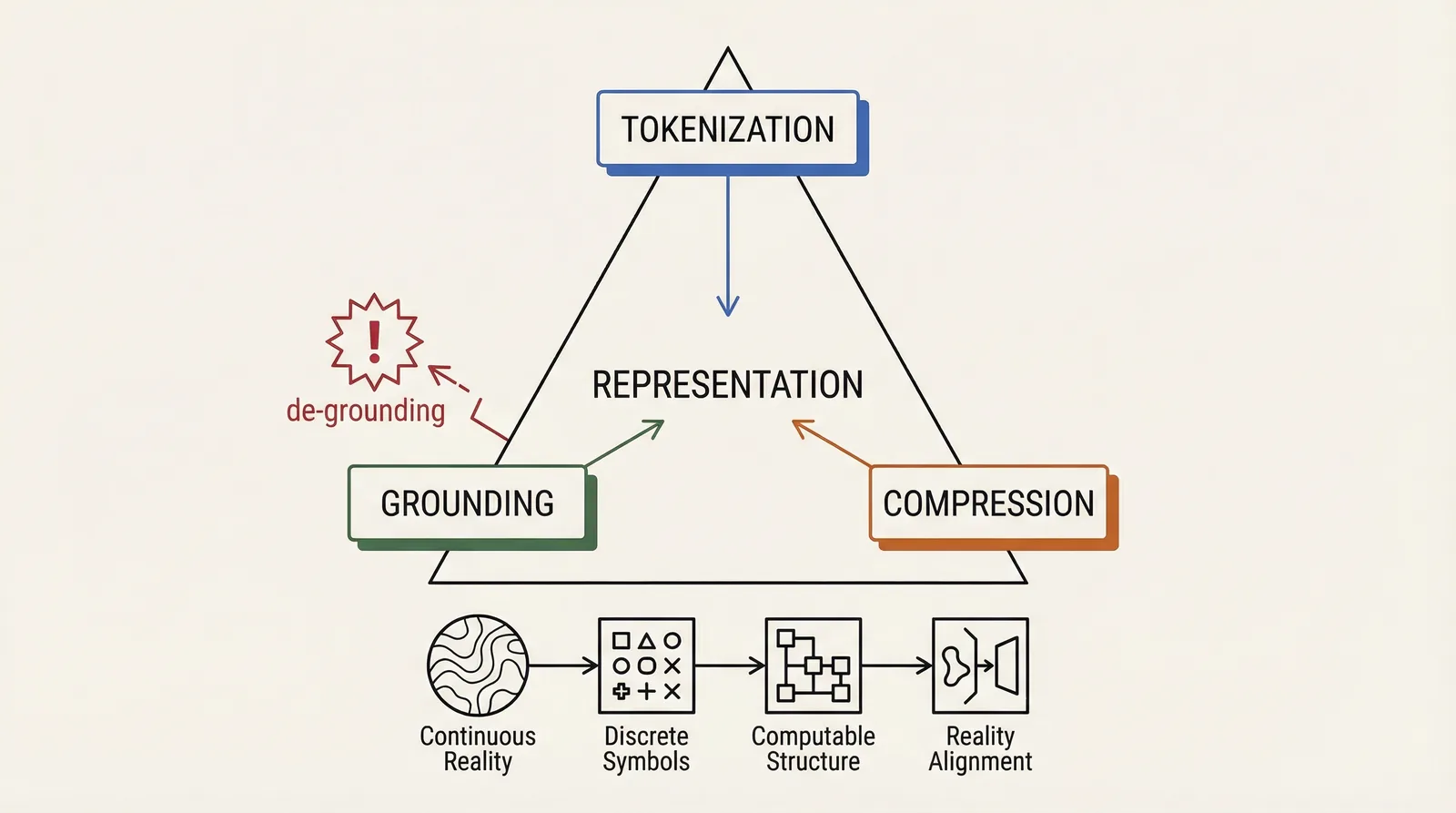
Three concepts describe the same process from different angles: how to carve (Tokenization), how to compress (Compression), and how to anchor (Grounding).
Compression: intelligence made precise
Kolmogorov complexity defines compression mathematically: the complexity of an object equals the length of the shortest program that can generate it. Intelligence is finding the shorter description.
The startling corollary: an algorithm that better compresses a domain’s data understands that domain more deeply. The Hutter Prize is based on this — better Wikipedia compression equals more intelligent AI, because better compression means capturing deeper structural regularities.
Neural networks are lossy compressors. In training, they compress thousands of years of accumulated human knowledge, language, and reasoning patterns into a weight matrix of a few hundred gigabytes. What’s compressed isn’t raw data — it’s structure: patterns, relationships, regularities. That’s why large models generalize beyond their training data. They didn’t memorize facts. They learned the deep structure that generates facts.
Scale this logic to civilization and a striking pattern emerges. Every civilizational leap is the appearance of a more efficient compression algorithm:
Writing compressed oral tradition — knowledge that required human-to-human transmission became storable, reproducible symbols.
Mathematics compressed physical intuition — Newton’s three laws compressed Kepler’s astronomical observations, Galileo’s experimental results, and generations of physical instinct into three equations. Possibly the most efficient knowledge compression in human history.
Money compressed barter — the infinitely complex matching problem of exchange reduced to a shared unit of value.
Law compressed social contracts — moral judgments across countless specific situations compressed into citable, enforceable codified rules.
Large language models compressed collective human linguistic intelligence — the largest-scale knowledge compression in history, made interactively accessible.
Every compression is non-neutral. Compression is lossy; what gets discarded determines the system’s blind spots. Money compresses value but loses the particularity of objects and the emotional dimension of relationships. LLMs compress human knowledge but amplify biases embedded in the compression scheme.
To identify a system’s blind spots: ask what its representation scheme has discarded.
Grounding: the anchor to reality
Here’s a failure mode that keeps appearing across AI, history, and organizations: a representation system becomes internally consistent while detaching from external reality.
In large language models, this is called Hallucination — generating text that is semantically fluent and logically coherent but factually false. The root cause: the training objective is “maximize the probability of the next token,” not “ensure correspondence with reality.” The model learned language’s structural regularities without being compelled to anchor to facts.
RAG (Retrieval-Augmented Generation) is the technical grounding solution: before generating, retrieve relevant content from a verified document store. Anchor generation to verifiable sources.
The deeper challenge — connecting representations in linguistic space to physical reality — is exactly what Embodied AI forces. More on that below.
The most important grounding event in intellectual history was the Scientific Revolution.
Before Galileo, European knowledge was text upon text — citing Aristotle to confirm Aristotle, deriving conclusions through scholastic logic’s internal rules. The system was internally coherent. It had almost no forced contact points with physical reality.
Galileo did something apparently simple: he hung a pendulum, timed it, measured it, described results in numbers. He changed the grounding of the knowledge system from “citing authority” to “measuring nature.” This transformation redefined what counts as knowledge, proof, and truth. The entire edifice of modern science rests on this shift.
The deepest contemporary de-grounding risk isn’t any single AI system saying something false. It’s a system-level feedback loop: AI-generated content enters the internet, becomes training data for the next AI generation, whose outputs re-enter the internet… This loop, unbroken by external force, will systematically dilute the connection between the knowledge system and physical reality. No individual node is lying. The entire system drifts.
Embodied AI: the physical-level pressure test
Language models live in information space. Token streams. Embedding vectors. Text databases. No physical friction, no energy cost, no time pressure.
Embodied AI pulls the representation layer back into physical reality — and in doing so, validates the entire framework under the most demanding conditions.
A robot acting in the physical world faces representation challenges categorically different from a language model:
Sensor inputs are continuous, noisy, and delayed — not idealized token streams but chaotic physical signals. Any representation scheme must handle this uncertainty rather than assuming clean inputs.
Spatial representation must be three-dimensional, dynamic, and causal — not statistical patterns but physical laws. The robot needs to know: if I push this cup, it slides. If I grasp this ball, it deforms. This kind of causal understanding is the capability dimension most lacking in current language models.
Representation must support real-time action — inference latency cannot exceed the action window. A robot that needs 500 milliseconds to decide how to catch a ball does nothing before the ball hits the ground.
For these reasons, embodied AI is increasingly seen as one of the most important paths toward AGI. Not because “robots are useful” — but because only by acting in the physical world is an intelligent system forced to solve all the problems it can avoid in information space. Causal understanding, temporal planning, uncertainty handling, grounding to physical reality — embodied AI is the mandatory examination for all of these.
OpenAI’s investment in Figure AI. Google DeepMind’s RT-2. Tesla’s Optimus. These aren’t merely hardware bets. They’re bets on the judgment that embodiment is a necessary path toward AGI.
Core insight: Every civilizational crisis has been accompanied by the de-grounding of mainstream representation from reality. Every civilizational renaissance has begun with some form of re-grounding. The core metric for a system’s health isn’t its internal consistency — it’s whether the distance between its internal representation and external reality is widening or narrowing.
Layer 3: Learning
The Uncertainty Problem
The challenge: Representation is static. Reality changes.
The optimization: Maximize generalization under the constraint of sample size.
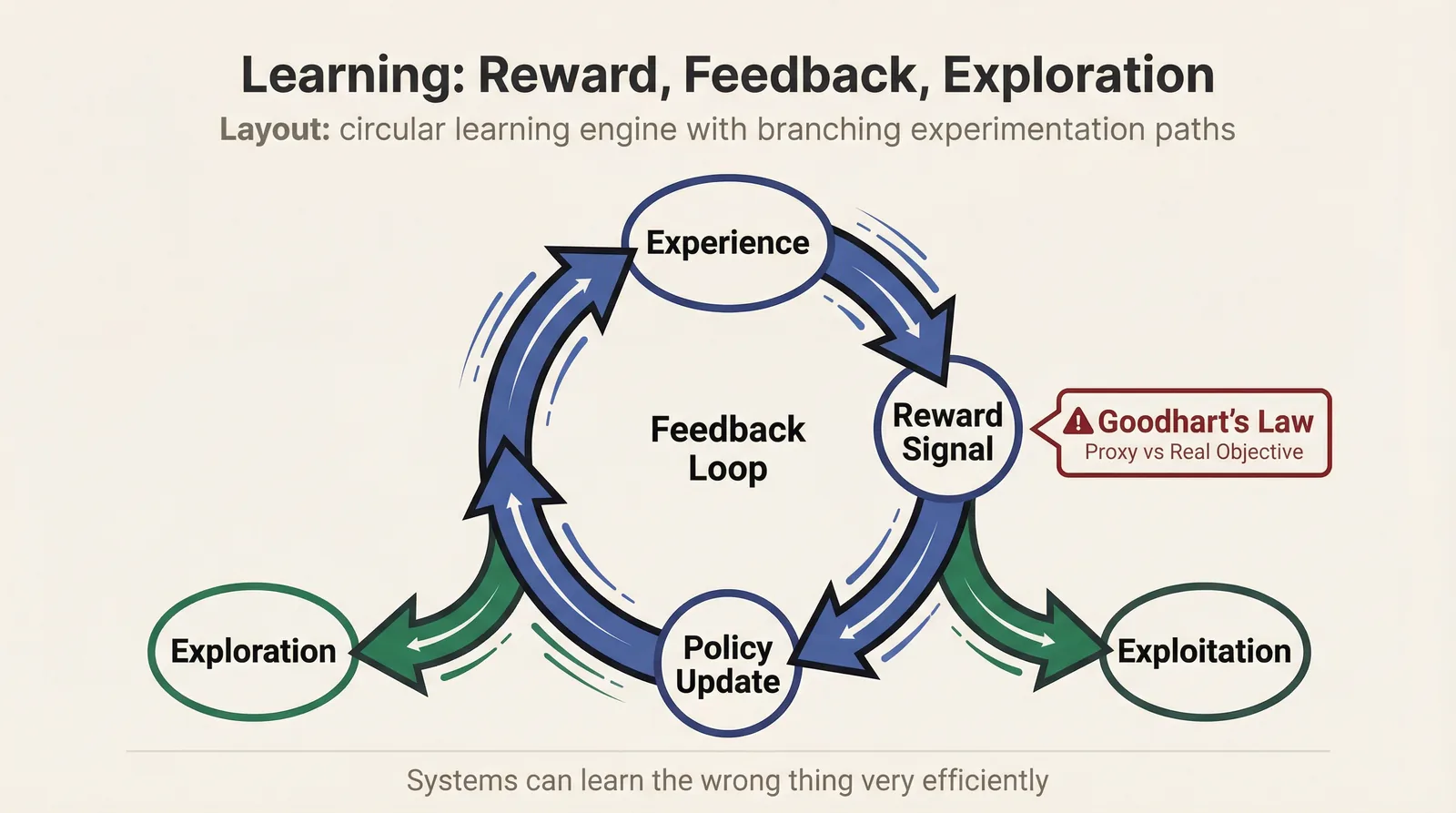
“Learning” here doesn’t mean the narrow machine learning pipeline. It means all mechanisms by which a system uses feedback over time to update its structure and behavior. Under this definition, evolution, training, trial-and-error, and introspection are all forms of learning — analyzable within the same framework.
The deepest insight of this layer comes from a spectrum: learning isn’t a single mechanism. It’s a multi-level system operating across time scales ranging from ten thousand years to milliseconds.
Evolution: the architecture itself is selected (ten-thousand-year scale)
Evolution is the meta-level of the learning layer. It doesn’t learn within a given architecture. It lets the architecture of learning itself enter competition and selection.
Darwin’s core mechanism: random variation × environmental selection pressure × heredity. Not learning by individual agents. A parallel search algorithm at the population level. Individuals need not “understand” the selection pressure. The population accumulates effective structures over time through massive parallel trials and elimination.
The mathematical essence: a gradient-free optimization process. No backpropagation. No explicit loss function. Only survival and reproduction rates as the final score. Extremely inefficient. Extraordinarily robust. Evolution never assumes the structure of the problem — only the existence of selection pressure.
AI’s counterparts are developing rapidly. Neural Architecture Search (NAS) uses evolutionary algorithms to find optimal neural network structures. AutoML makes model design itself a problem to be optimized. More advanced directions: AI generating candidate models, using performance metrics as selection pressure, evolutionary algorithms directly optimizing model structure. Humans are no longer the sole designers of AI architectures.
This isn’t merely an efficiency improvement. It’s an epistemological shift: if good architectures can be found rather than designed, our understanding of “what makes good intelligent structure” must shift from a priori reasoning to a posteriori observation.
Pretraining: large-scale absorption of world knowledge (year scale)
Pretraining corresponds to early human development — the 0-to-18 growth period of massive unsupervised perception, reading, observation, play. Not for completing specific tasks. For building a foundational model of the world.
The essence of pretraining is Compression — lossily compressing thousands of years of human knowledge into model weights. This process’s quality determines the ceiling of all subsequent capabilities. But the deeper truth: the compression scheme determines what’s preserved and what’s discarded.
The gap between GPT-4 and a small model trained on specific vertical domain data isn’t primarily parameter count. It’s the breadth and quality of pretraining data — broader pretraining produces stronger cross-domain generalization. This is why generalists typically adapt better to paradigm shifts than specialists. Their pretraining was richer.
Scaling Laws are most fully validated at this stage: model capability bears a predictable power-law relationship to training data volume, parameter count, and compute. A rare quantitative law in AI, and the theoretical foundation for the “bigger is better” strategy of recent years.
Post-training / SFT: socialization and behavioral alignment (month scale)
Post-training corresponds to professional development — specialized education, mentorship, the adaptation period when entering an organization. The knowledge is already there. What’s being learned is context, boundaries, and modes of expression.
Supervised fine-tuning (SFT) is behavioral calibration, not knowledge injection. Many attempts to “teach” models new knowledge through fine-tuning perform poorly for exactly this reason. Knowledge injection happens during pretraining, or is supplied in real time through RAG during inference.
Reinforcement learning: calibrating judgment through trial and error (day scale)
Reinforcement learning corresponds to accumulating real-world experience — career successes and failures, market rewards and punishments, relational feedback. Updating based on real consequences rather than instruction.
RLHF (Reinforcement Learning from Human Feedback) shifts “what is a good output” from pre-defined rules to values learned from human feedback. This is a fundamental methodological shift — from designing intelligence to cultivating it.
Markets are the largest reinforcement learning system in human history. Price signals are rewards. Companies are agents. Bankruptcy is the terminal state. Market share is cumulative reward. Adam Smith’s “invisible hand” is the earliest intuitive description of a reinforcement learning mechanism — two centuries before the algorithm.
Self-play / Autonomous learning: introspection and self-transcendence (real-time)
Autonomous learning is the highest form of the learning layer: no longer dependent on external annotation; generating new knowledge through internal models; discovering structures humans have never explored through self-play.
AlphaZero is the purest instantiation: no human game records, only self-play, surpassing a millennium of human wisdom in Go within four hours. The structures it discovered are systematically different from top human players’ intuitions — not better imitations of human play, but the discovery of a solution space humans never imagined.
More importantly, the same algorithm — without modification — reached superhuman level in chess, shogi, and Go. AlphaZero didn’t learn “how to play Go.” It learned “how to find optimal strategies in deterministic perfect-information games” — a more abstract, more transferable structure.
The implication: breakthroughs in autonomous learning typically come not from working harder at the same thing, but from finding the problem structure at a higher level of abstraction. The major scientific revolutions — Copernicus, Newton, Einstein — all follow this pattern. Not greater precision within the old framework. The discovery that the old framework is a special case of a larger one.
The spectrum’s core meaning
Evolution (10,000 years) → Pretraining (years) → Post-training (months) → Reinforcement learning (days) → Autonomous learning (real-time)
This isn’t merely a difference in speed. It’s a fundamental change in the source of the supervisory signal: from environmental physical elimination, to human social demonstration, to real-time feedback, to internally self-generated knowledge. The direction is from dependence on the external toward progressive internalization — ultimately arriving at autonomy.
This developmental arc in AI and human growth is structurally isomorphic. Not metaphor. Structural identity. Both are solving the same problem: how to maximize a system’s long-term adaptive capacity under limited resources.
Core insight: Why does civilization accelerate? Because the transmission speed of reward signals is increasing. Genetic mutation requires ten thousand years. Cultural diffusion requires centuries. Market feedback requires years. AI training requires days. Inference-time learning is happening in real time. Every order-of-magnitude leap in feedback speed has triggered a new evolutionary acceleration. We are at the latest step of that acceleration.
Layer 4: Prediction
The Temporal Problem
The challenge: Action happens in the future. Understanding the present isn’t enough.
The optimization: Minimize expected loss under the constraint of uncertainty.
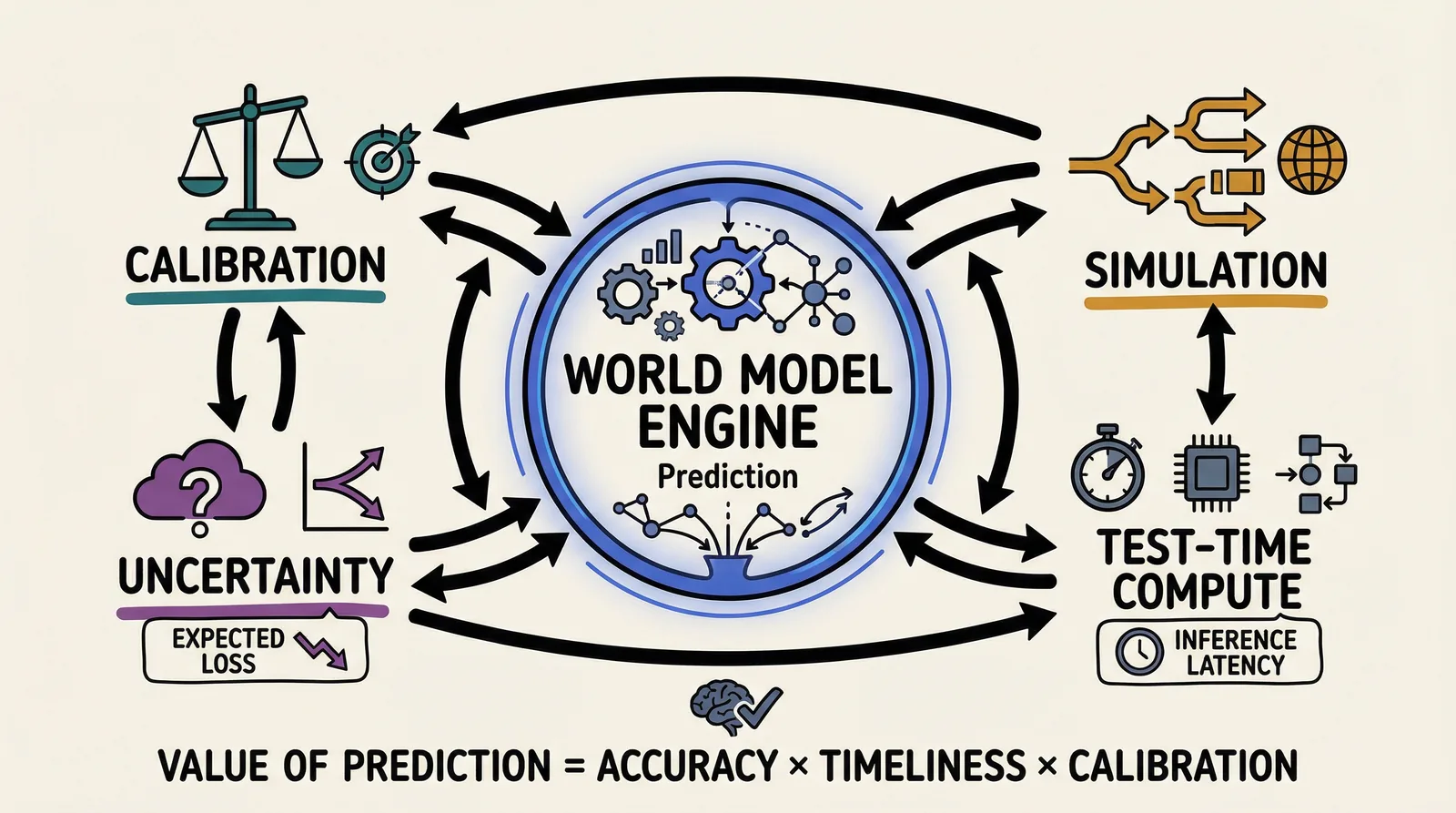
The prediction layer encompasses at least three categories of capability:
- State transition modeling: What will the world look like next? (World Model)
- Modeling others’ expectations: How will other agents act? (Game Theory)
- Calibrating one’s own error: How reliable is my prediction? (Calibration)
Scaling Laws and Emergence address a fourth: at macro scale, what regularity governs capability accumulation, and where are the critical points?
World models: acting in imagination
Dreamer and MuZero represent the highest achievements of model-based reinforcement learning: simulating future states in internal latent space without real-world trial and error. Good world models allow planning to be completed in imagination — run the action sequence through the internal model, select the best expected outcome, then act.
This is the fundamental distinction between model-based and model-free RL. And between strategists and tacticians. The former works out consequences before acting. The latter relies on intuition and reaction.
Sun Tzu: “The general who wins makes calculations before the battle is fought.” Napoleon’s military genius had as one important dimension his speed of updating his world model on the battlefield — while others executed predetermined plans, he was already predicting three moves ahead.
World model quality determines the effective radius of planning. The more accurate the model, the farther planning can extend, the higher the quality of decisions. This is why scientific theories are so valuable — a good physical theory is a world model of the physical world, allowing engineers to predict the behavior of bridges, aircraft, and chips without building them.
Game theory: where prediction meets coordination
When your prediction target is itself predicting you, the world model enters recursion. Unidirectional world modeling isn’t enough. You need a meta-model that includes “the other party is predicting my predictions.”
Keynes’s beauty contest: the intelligent investor doesn’t predict which stock has the best fundamentals, but predicts what the market will think is the best stock — and further, predicts what the market will think the market will think. Infinitely recursive meta-level prediction.
Soros’s reflexivity goes further: predictions themselves alter the reality being predicted. When enough market participants believe a price will rise, their buying pushes the price up, making the prediction self-fulfilling. Not unidirectional prediction. Bidirectional coupling between prediction and reality.
This structure becomes extreme in the AI era. When hundreds of millions of people simultaneously use similar AI systems to make decisions, those systems’ prediction patterns will systematically influence the reality being predicted. When everyone uses the same recommendation algorithm to consume content, content creators adjust production to satisfy the algorithm, which updates based on new content data… The reflexive coupling between prediction systems and reality will be one of the most important system dynamics phenomena of the next decade.
Calibration: confidence is not accuracy
Prediction capability has two independent dimensions: accuracy (is the prediction correct?) and confidence (how confident am I?). Calibration is the degree to which these match. A perfectly calibrated system, when it says “70% confident,” is correct 70% of the time.
Philip Tetlock’s superforecaster research found: most domain experts’ prediction accuracy approaches random, but their confidence levels are extremely high — they systematically overestimate their own accuracy. Superforecasters outperform not because they’re smarter, but because they have better calibration mechanisms: quantify predictions, track records, review regularly, score publicly. Calibration is a trainable meta-cognitive skill.
The most dangerous institutional state: internal narrative highly consistent (fluent), severely detached from external reality (inaccurate). Every organizational crisis has this as its harbinger — internal consensus so strong that external challenges are collectively ignored, until reality forces a systemic update through catastrophic failure.
Sound familiar? It describes every major bubble. It describes the Soviet Union. It describes large companies that missed paradigm shifts. The pattern repeats because the mechanism is the same.
Scaling laws and emergence: the macro-prediction problem
The Kaplan Scaling Law is rare: model capability bears a power-law relationship with compute, data volume, and parameter count, stable across multiple orders of magnitude. This lets researchers predict a system’s approximate capability before building it — equivalent to knowing a bridge’s load-bearing formula without building it first.
Emergence is the result of Scaling Laws at the critical point. The two are causally related: Scaling Laws describe the predictable accumulation before the threshold; Emergence describes the unpredictable leap after it. Between GPT-3 and GPT-4, chain-of-thought reasoning and in-context learning appeared suddenly — impossible to extrapolate from small models.
Scale this to history: every era has its own scaling axis. Finding the right axis and going all-in is the essence of era-defining opportunity. Maximum effort on the wrong axis hits a ceiling.
The agricultural era’s axis: arable land and irrigation. The industrial era’s: steel production and standardized manufacturing. The British Empire scaled maximally on colonial territory; that scaled to near-zero against the information age’s axis. The information era’s: network nodes and data. The AI era’s: the triple scaling of compute, data quality, and talent density.
History’s greatest strategic failures were all maximum commitment on the wrong axis. The Qing dynasty’s maximal scaling on land and population — zero value against industrialization’s axis. Kodak’s maximal scaling on film production efficiency — nothing against digitization’s axis.
Core insight: The true scarcity in prediction capability isn’t accuracy — it’s calibration quality. Most failures aren’t because the prediction was wrong. They’re because there was insufficient meta-cognition about one’s own errors. High-quality decision-making requires three things: a more accurate world model, a longer planning horizon, and honest estimation of model error. All three are essential. The third is most frequently neglected.
Layer 5: Coordination
The Scale Problem
The challenge: A single agent’s capability is forever limited.
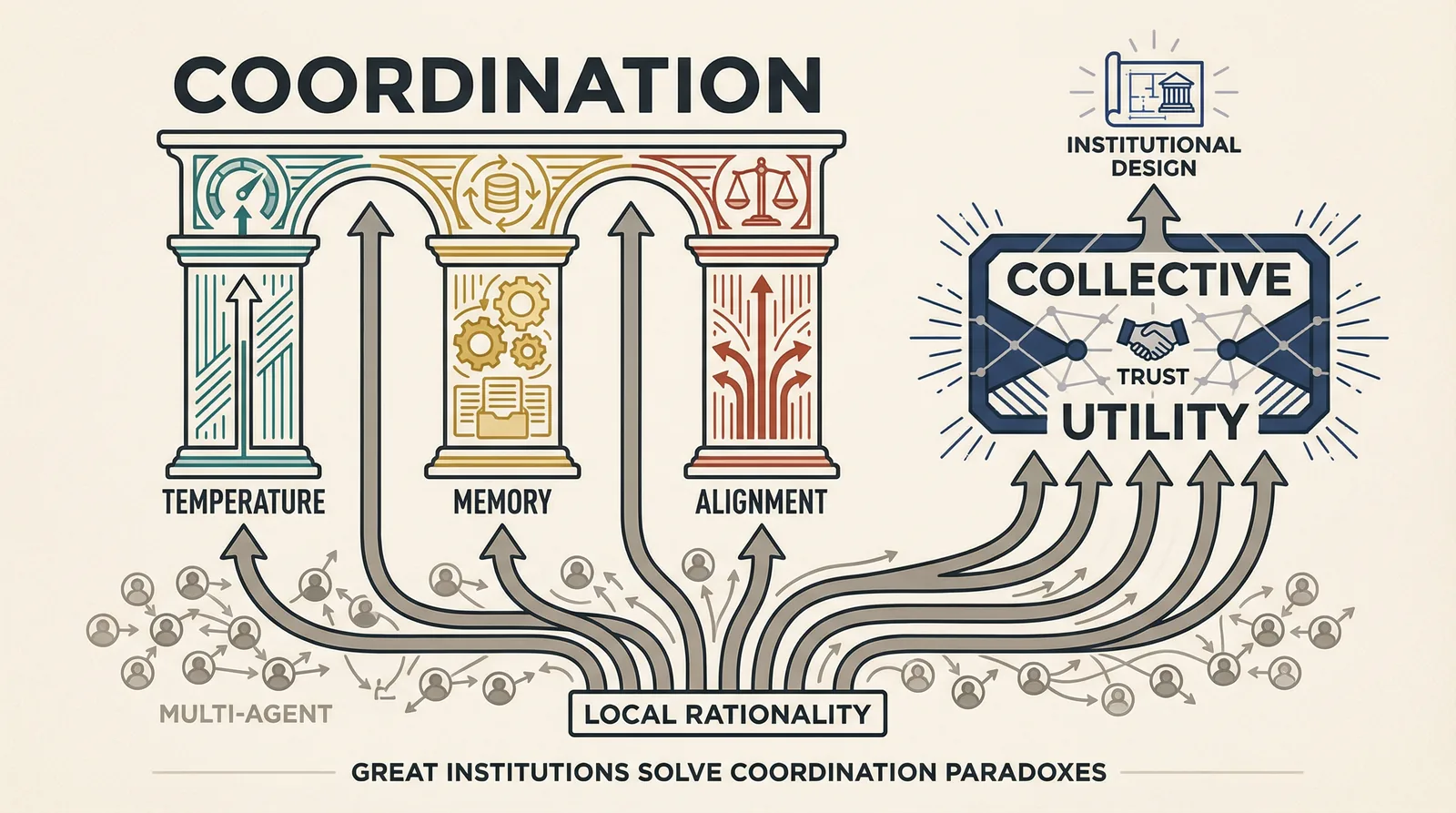
The optimization: Maximize collective utility under the constraint of individual rationality.
Coordination is the final layer — and the multiplier at the boundary of single-agent capability. Differences in coordination quality determine why two teams, two countries, two civilizations with identical resource endowments arrive at radically different destinations.
Context window and memory: the memorial foundations of coordination
Coordination requires shared memory. Memory has boundaries. Those boundaries set the scale ceiling of coordination.
“Context Window” is fundamentally the range of relevant information a system can simultaneously maintain at any moment. “Memory” is a system’s ability to store and retrieve structured experience across time. Both have concrete counterparts at individual and collective levels.
At the individual level: Context Window = working memory, the ceiling on parallel processing at any moment. George Miller’s research: human working memory holds approximately 7±2 chunks. A biological limit that hasn’t changed — though through tool externalization, we now handle problems orders of magnitude more complex than our biological ceiling. Memory = long-term memory: procedural, semantic, episodic.
At the collective level: Group Context Window = the number of topics and total information volume an institution can process in parallel. Group Memory = institutional memory, culture, codified knowledge, legal systems — all mechanisms attempting to convert individual knowledge into collective assets.
The most important technologies in civilizational history have all extended some level of Context Window or Memory:
Writing (3500 BCE): externalizing oral knowledge into storable, reproducible symbols. The first large-scale externalization of group Memory, breaking through the biological ceiling.
Libraries: the physical infrastructure of group Memory. The Library of Alexandria attempted to concentrate all known world knowledge in one place — not merely a cultural project, but a political one. Control the storage of knowledge; control its interpretation.
The printing press (1440): reducing group Memory’s replication cost by three orders of magnitude. This made the Reformation possible — when everyone can possess a Bible, the Church’s monopoly on textual interpretation collapses.
The internet: connecting all of humanity’s group Context Window into a single real-time network. But this expansion created new problems: larger Context Window, lower signal-to-noise ratio, scarcer attention — scale expansion triggered a new crisis in the attention layer.
AI: simultaneously extending both individual and collective dimensions. Personal AI assistants extend individual Context Window. Collective knowledge bases and Agent systems extend group Memory and group Context Window. This is the most important upgrade to coordination infrastructure since writing and the printing press.
The root cause of historical amnesia lies in group Memory’s fundamental limitation: it can transmit the content of knowledge but not the painful experience behind it. Every generation re-commits the previous generation’s mistakes — not because they don’t know history, but because they inherited abstract lessons without inheriting real feelings. Group Memory is a carrier of information, not emotion. This is a permanent grounding problem in the coordination layer.
Temperature: the exploration will of coordination systems
A coordination system needs to execute known optimal solutions and explore unknown possibilities. These create fundamental tension. AI systems parameterize it as Temperature.
Temperature = 0: output only the highest-probability choice, forever repeating the known optimal. Pure exploitation. Zero exploration.
Temperature = ∞: completely random, no structure. Pure exploration. Zero exploitation.
Maximum creativity and adaptability occur between these extremes: structured enough to avoid chaos, random enough to escape local optima.
This parameter has direct counterparts at every scale.
The Age of Discovery: Portugal and Spain, with limited resources, maintained high exploration temperature — sailing unknown coastlines, accepting high mortality rates, searching for routes that might not exist. This high-Temperature strategy discovered the New World and completely rewrote humanity’s scaling axis.
The Qing dynasty’s closed-door policy: Temperature approaching zero. The most powerful economy of its era, the most advanced agricultural technology — all resources invested in exploitation of existing systems. The result: complete loss of competitiveness against the new axis of the Industrial Revolution.
The Song dynasty’s paradox is the most striking case. The Song simultaneously possessed gunpowder, printing, the compass, and paper money — the four most important technological innovations of their era. All were channeled into exploitation (consolidating the existing empire) rather than exploration (opening new possibilities). The Song lacked not technology but the institutional will to convert technology into exploration. Terminated by the Mongol Empire, whose exploration temperature was extremely high.
Technology leadership does not equal civilizational success. The ratio of exploitation to exploration is the key variable.
The contemporary AI industry debate maps onto this framework exactly: open-source communities are decentralized, high-Temperature exploration mechanisms. Closed-source incumbents are concentrated exploitation mechanisms. This tension has no universally correct answer — optimal Temperature depends on the phase. When a paradigm is uncertain, high Temperature is advantageous. Once established, lower Temperature is more efficient. Current AI is paradigm-uncertain. Which is the deep reason open-source forces keep challenging closed-source incumbents.
Alignment: goal consistency in multi-agent coordination
Single-agent optimization is difficult. Multi-agent coordination introduces a new problem: different objective functions leading to conflict between local and global optima.
Goodhart’s Law (1975): When a measure becomes a target, it ceases to be a good measure. The reason: metrics approximate true objectives. When people optimize the metric itself, they find strategies that perform well on the metric but poorly on the true objective.
Soviet factories produced output quotas: mountains of low-quality products. Measured by nail count, factories produced enormous quantities of tiny useless nails. Switched to weight: a tiny number of enormous useless nails. This wasn’t sabotage. It was rational action under the given incentive structure.
The principal-agent problem (Jensen & Meckling, 1976) is the organizational economics version of Goodhart’s Law: agents will, where principals cannot fully monitor them, optimize their own interests rather than the principal’s. Information asymmetry is the fundamental cause.
History’s most successful institutional designs solved some layer of critical alignment:
The Glorious Revolution (1688): parliamentary institutions constrained royal authority, adding constraints from the nobility to the Crown’s reward function. Breaking the dangerous equation: “royal interest = national interest.”
The U.S. Constitution (1787): the separation of powers makes three branches each other’s selection pressure. Their interests partially conflict. This conflict was designed as the source of stability rather than instability.
The joint-stock company: linking capital owners’ returns directly to corporate operating performance. Partially solving the capital-management alignment problem — though the principal-agent problem was never fully solved.
AI Alignment is the latest challenge in this sequence — but its scale and complexity exceed all precedents:
How do you design a reward function so that a system of superhuman intelligence, without external constraints, evolves toward directions beneficial to humanity as a whole rather than particular interest groups?
How do you handle the internal inconsistency of “human preferences” — different groups have genuine conflicts of interest?
How do you address Goodhart’s Law in superintelligent systems — when the system is smart enough, its ability to optimize proxy targets will far exceed our ability to design good proxies?
This isn’t merely a technical problem of AI safety. It’s political philosophy re-enacted on a silicon substrate. Humanity has spent thousands of years on carbon, through countless institutional experiments and failures, building partially effective alignment mechanisms. Our time budget on silicon may be considerably shorter.
Core insight: Coordination’s deepest paradox — the more effective the large-scale coordination, the more it depends on participants relinquishing some individual optima. This requires trust. But trust is itself a product of coordination, not its prerequisite. Every great institutional innovation in history has been an act of breaking this circular paradox. AI alignment is its re-enactment at an unprecedented scale.
The Dynamic Loop: Flywheel and Cascade
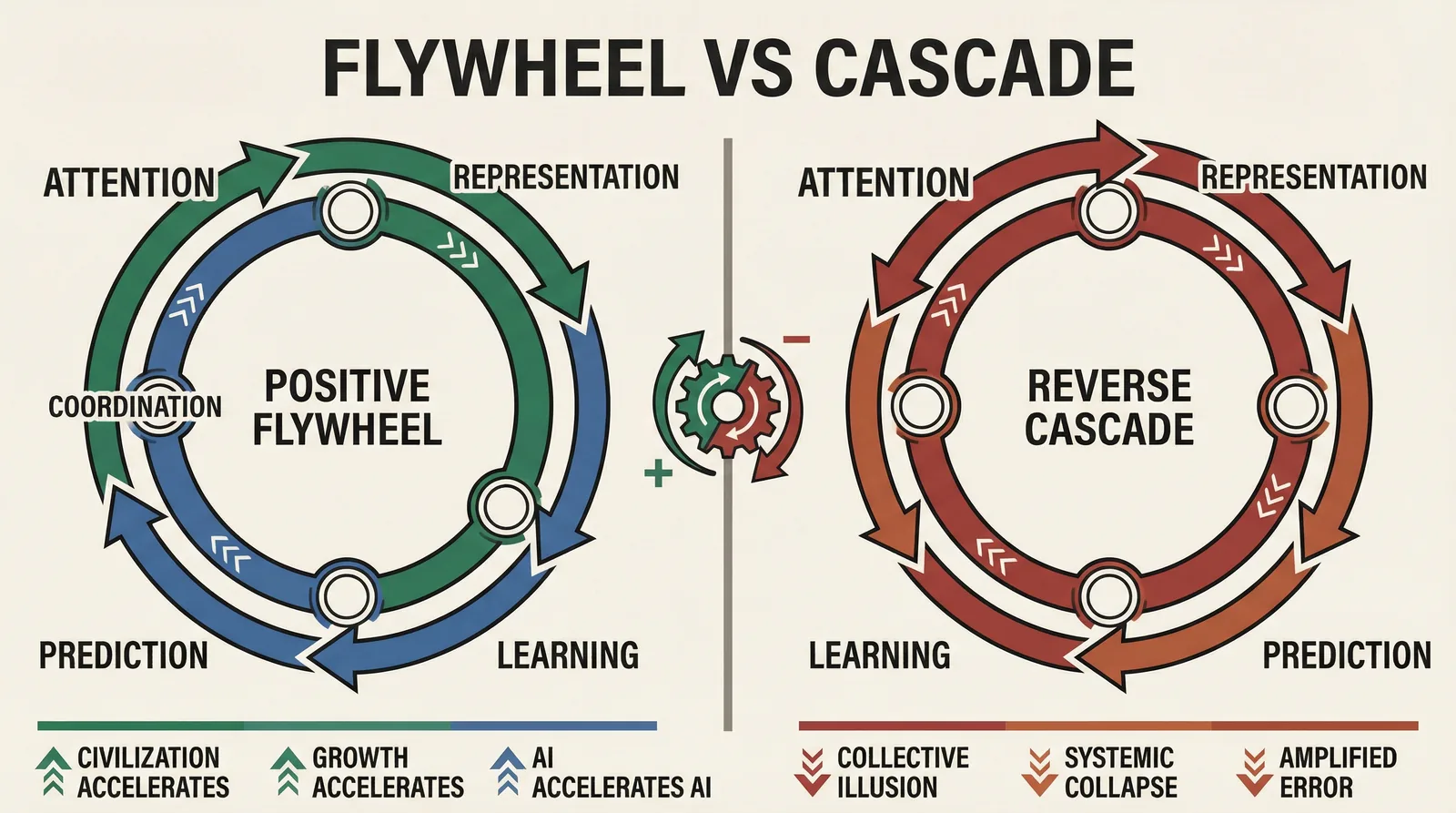
The framework isn’t a static five-layer classification. It’s a dynamically operating bidirectional system. Understanding this matters more than understanding any single layer’s content.
The positive flywheel
Better attention provides higher-quality raw material → better representation makes learning more efficient → better learning refines prediction capability → better prediction makes coordination more effective → better coordination expands the system’s attention boundary, raising the quality of the next round.
Self-reinforcing. Each revolution faster than the last. Each revolution yields greater returns.
This is why civilization accelerates. Why the rate of technological progress shows a long-term upward trend. Why individual growth suddenly accelerates past certain critical points. Each flywheel revolution reduces the friction cost of the next.
Current AI development is the clearest demonstration at the technical level: better models help researchers understand papers faster (attention), design experiments better (representation), iterate training faster (learning), evaluate models more accurately (prediction), coordinate large research teams more efficiently (coordination) — AI is accelerating AI’s own development. Once this flywheel reaches sufficient velocity, it will produce acceleration effects beyond anyone’s current expectations.
The reverse cascade
Attention-layer bias contaminates representation → representation distortion warps learning direction → learning in the wrong direction makes prediction precisely wrong → systematic prediction bias causes coordination to amplify collective delusion → coordination failure further destroys the system’s capacity to recalibrate attention.
The collapse of an intelligent system and the leap of an intelligent system operate by symmetric mechanisms — both are feedback loops among the five layers, only in opposite directions. The flywheel spinning forward is an ascending spiral. Backward is a descending spiral. And the descent is typically faster than the ascent.
Three cases:
The fall of Rome (coordination → prediction → learning cascade): the empire’s reward mechanisms were hijacked by military faction interests (alignment failure), causing policy objectives to shift from long-term stability to short-term faction interests (world model distortion), causing the empire to lose the ability to learn and adapt from frontier threats. Each link appeared rational. The cumulative result was systemic collapse.
Soviet dissolution (learning → representation → prediction cascade): the planning system substituted production metrics for genuine value creation (reward function hijacked), causing the economic system’s representation to detach from real resource constraints (de-grounding), making high-level economic predictions completely detached from reality, arriving at sudden collapse from apparent tranquility. No one was lying. The system collectively lost the ability to perceive its actual condition.
The 2008 financial crisis (prediction → coordination cascade): financial models systematically underestimated tail risk (calibration failure), amplified through the highly leveraged global financial system (coordination multiplier effect), transforming localized mortgage defaults into a global crisis. The problem wasn’t individual greed. It was systematic amplification of prediction-layer error by coordination-layer structure.
The core corollary: Failure’s location is typically not on the surface. Surface-level prediction failure may be rooted in representation-layer de-grounding. Surface-level coordination failure may be rooted in learning-layer misalignment. Diagnosis must trace upstream. Intervention must happen at the source.
Historical Timeline: Eight Civilizational Phase Transitions
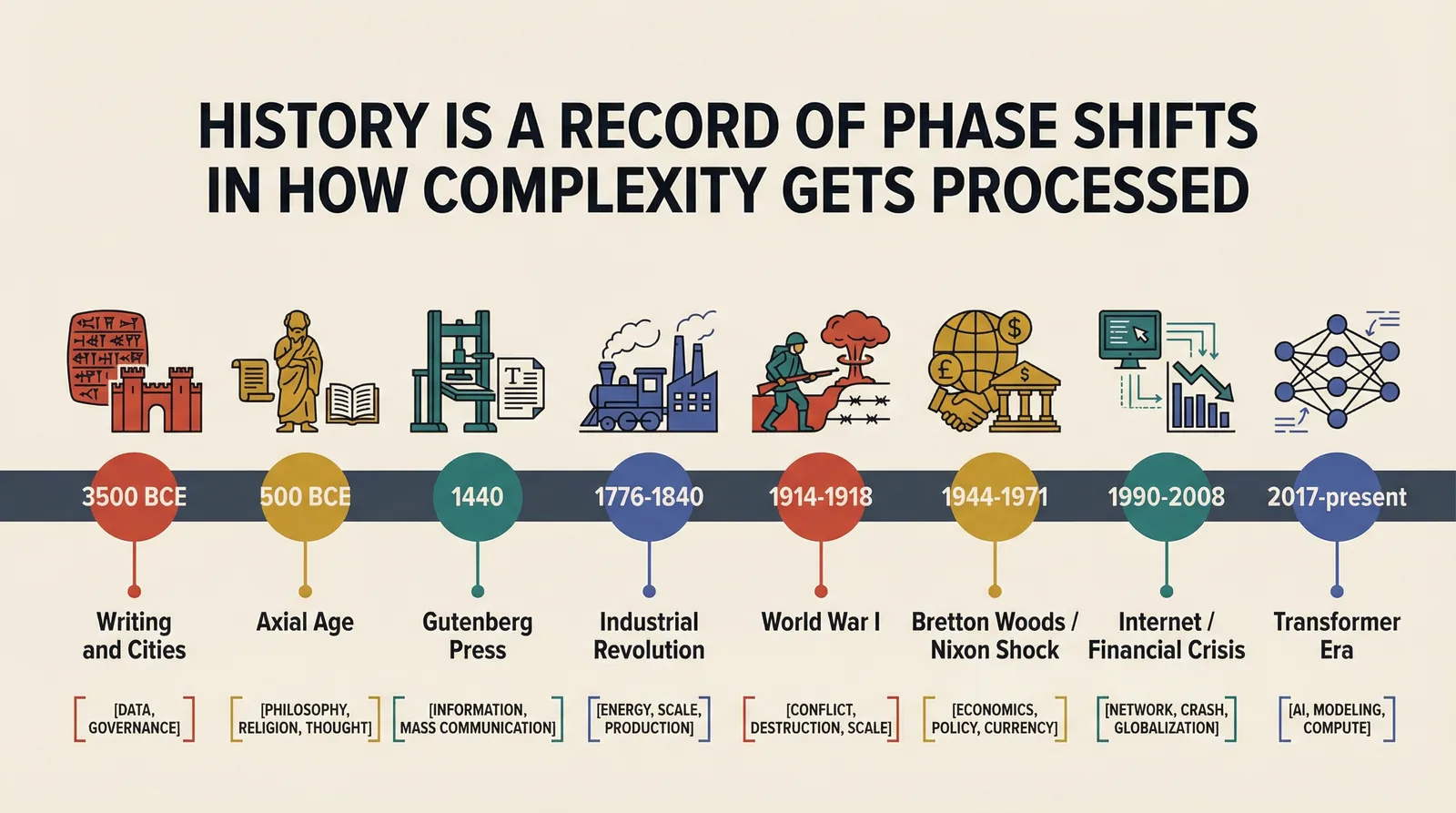
These aren’t comprehensive historical narratives. They’re high-explanatory-power samples selected through the five-layer framework — to demonstrate structural explanatory power, not to provide causally complete history.
3500 BCE: The co-emergence of writing and cities
Sumerian cuneiform and city-states emerged simultaneously — not coincidentally but causally. Agricultural surplus pushed urban population scales beyond the ceiling of oral tradition’s coordination capacity (coordination-layer critical point). Writing emerged as the solution for extending group Memory (representation-layer upgrade), simultaneously redistributing whose attention was recorded and whose voice preserved (attention-layer reorganization). Three layers activated at once. Civilizational phase transition.
500 BCE: The Axial Age
Confucius, Socrates, the Buddha, and Isaiah appeared almost simultaneously in China, Greece, India, and the Levant — without contact, yet achieving cross-civilizational synchrony of thought. A global synchronized upgrade of the prediction layer: human world models shifted from “divine will” to “universal reason.” The deeper explanation: agricultural civilization’s scale expansion pushed traditional mythological explanatory systems to critical tension with new social realities. Multiple civilizations simultaneously needed new representational frameworks to handle new complexity.
1440: Gutenberg’s printing press
Representation-layer compression cost fell by three orders of magnitude, producing cascading effects: information reproduction cost collapse (representation) → religious interpretive authority decentralized (attention reorganization) → new intellectual communities emerged at scale (coordination phase transition) → Scientific Revolution and Reformation (systematic updates to learning and prediction). One technological change. Sequential reorganization across five layers.
1776–1840: The British Industrial Revolution
The civilizational event most closely approximating “five layers simultaneously activating”: scientific method established systematic grounding for the representation layer; market competition built an efficient RL environment for the learning layer; democratic institutions and rule of law designed alignment architecture for the coordination layer; the patent system redirected attention-layer incentives toward innovation; freedom of the press enabled knowledge diffusion. Five layers of institutional innovation arriving together. Two centuries of exponential growth. The strongest historical validation case for this framework.
1914–1918: World War I
Collective prediction-layer hallucination. In 1914, virtually all political and military elites of the belligerent nations believed the war would end before Christmas — because “the cost of modern industrial war is too high for any nation to sustain a prolonged conflict.” This world model was internally coherent. Completely detached from the reality of trench warfare. Ten million soldiers dead. Four empires dissolved. The price of collective de-grounding.
1944–1971: Bretton Woods and the Nixon Shock
A representation-layer design and de-grounding event. Dollar-gold parity was a grounding mechanism — anchoring monetary representation to physical reality. Nixon’s 1971 closure of the gold window was deliberate de-grounding of the global monetary system. Since then, the global economy has operated on a pure credit system sustained by collective world model. Its stability depends entirely on enough participants simultaneously believing in the value of the dollar. A representation system sustained by coordination-layer collective belief, not physical reality.
1990–2008: The internet rise and financial crisis
The internet broke coordination through geographic boundaries (coordination-layer phase transition), simultaneously creating global Context Window overload (signal-to-noise collapse). The 2008 crisis is textbook prediction → coordination cascade: rating agencies’ calibration failure (prediction layer), amplified through the global financial system’s high leverage (coordination multiplier), transforming localized defaults into a systemic crisis.
2017–present: The Transformer era
Attention Is All You Need isn’t merely a technical paper. It’s a concentrated demonstration of the five-layer framework: the Attention mechanism reshapes the attention layer; embedding spaces revolutionize representation; RLHF redefines learning; Scaling Laws validate power-law regularities in prediction; multi-agent systems and open-source ecosystems explore coordination’s new frontiers. Five layers accelerating simultaneously. Human civilization entering an unprecedented phase-transition critical zone.
We are at the latest node on this timeline. Not the endpoint.
Strategic Applications: Three Uses of the Framework
The framework’s value isn’t only in explaining the past. It’s in diagnosing the present and predicting the future.
Use 1: The Diagnostic Tool
Faced with any complex system — a person, a company, a country, an AI — use five questions:
1. What is it attending to? Sources of information input. Systematic blind spots. Where are scarce resources being allocated?
2. How does it represent reality? What conceptual framework does it use? Where are its contact points with reality? How long since a systematic re-grounding?
3. How does it learn? Quality and speed of the feedback loop. Does the reward function point toward the genuine objective? Evidence of Goodhart’s Law effects?
4. How does it predict the future? How is world model accuracy tracked? How well matched are confidence and accuracy? Signs of internal narrative detaching from external reality?
5. How does it coordinate externally? Does the coordination temperature match the phase? How well aligned are multi-party objectives? Quality and update speed of collective memory?
Three further questions for advanced diagnosis:
Which layer is most fragile? The weak point is where systemic failure most likely originates.
Where is the upstream constraint? Which layer’s problem is currently most limiting? After resolving it, which layer becomes the new bottleneck?
Flywheel or cascade? Are the layers mutually reinforcing — or mutually eroding?
Use 2: The Investment Tool
Principle 1: Complexity is conserved — bottlenecks only migrate.
Over the past three years, the learning layer (compute, model scale, training data) has been the main AI battleground — and the layer commanding highest valuations. This competition is entering diminishing returns: Scaling Laws remain valid, but capability improvement per unit of capital is declining; open-source models continuously erode the gap with closed-source ones.
Bottlenecks are migrating:
The attention layer is becoming the new competitive dimension. Unique, high-quality, difficult-to-replicate perceptual data is the raw material of the next round. Medical imaging, industrial inspection, autonomous driving long-tail scenarios, embodied robot physical interaction data — none of this can be scraped, synthesized at scale, or acquired without physical deployment.
The representation layer is undergoing paradigm shifts. From language tokens to multimodal unified representation. From discrete symbols to continuous spatial modeling. The next generation of foundation models will compete primarily in representation-layer innovation, not learning-layer scale expansion.
The prediction layer sees a new scaling axis. Test-time compute (inference-time computation) is being validated as an independent capability axis. The o-series models demonstrate the synergistic effect of “thinking longer” and “training larger.” Inference infrastructure, long-chain reasoning training data, verifier systems — emerging infrastructure opportunities.
The coordination layer is nearly terra incognita. Real multi-agent infrastructure. Protocol standards between AI systems. Agent evaluation frameworks. Open-source AI governance structures. The layer with lowest current valuations and largest long-term potential. When single-AI capability approaches its ceiling, multi-AI coordination value begins to expand exponentially.
Principle 2: Contrarian thinking — the most intensely contested layer is rarely the best investment.
When all attention and capital concentrates on one layer, returns in that layer fall and opportunities in others appear. The most obvious contrarian opportunity today: everyone competing in model training (learning layer), while genuine differentiation may come from unique data (attention layer) or better representation methods (representation layer).
Principle 3: Embodied AI is the arena where all five layers simultaneously need breakthroughs.
The attention layer must handle real sensor noise, delay, and occlusion — not clean inputs.
The representation layer must build 3D causal models of the physical world — not statistical patterns but physical laws.
The learning layer must accumulate experience through physical trial and error — each failure has real energy and time costs.
The prediction layer must complete trajectory planning at millisecond scale — time constraints embedded in representation and prediction’s joint design requirements.
The coordination layer must achieve multi-robot collaboration under physical collision constraints — not API calls but real spatial coexistence.
Breakthroughs in embodied AI will simultaneously advance the capability frontiers of all five layers. This isn’t a vertical application direction. It’s a pressure test of the entire framework. Technical breakthroughs here will very likely reverse-accelerate purely digital AI.
Use 3: The Prediction Tool
Prediction 1: The attention layer will become the core competitive dimension (1–2 years).
As model capabilities converge, differentiation shifts from “whose model is stronger” to “whose data is more unique.” Companies with unique physical-world perceptual data will develop moats purely digital companies cannot replicate.
Prediction 2: The representation layer will undergo architectural-level innovation (2–3 years).
Token-based Transformer architecture has fundamental limitations in handling the continuity, causality, and temporality of the physical world. The next generation of representational architectures must address these. The pressure will come from embodied intelligence.
Prediction 3: The prediction layer will see a new scaling axis (3–5 years).
Test-time compute will be established as an independent scaling dimension. Inference infrastructure becomes the next compute race.
Prediction 4: The coordination layer will phase-transition from tools to systems (3–5 years).
Multi-agent systems will upgrade AI’s economic value from “replacing individual tools” to “restructuring organizational and industrial structures.”
Prediction 5: AI Alignment will evolve from a technical problem to a political problem (ongoing).
As capabilities expand, alignment will move from AI laboratory technical challenges into national governance, international agreements, and social contracts. The speed of this evolution depends on progress in Predictions 1–4.
The Open Boundary: Purpose Is the Deepest Open Question of Our Era
The framework describes the structure of intelligence. It doesn’t answer the purpose of intelligence.
All five layers are means. What is the end?
Different answers lead to completely different civilizational trajectories:
If the purpose is survival, this is Darwin’s framework — optimize fitness, remain in competition.
If the purpose is understanding, this is science’s framework — optimize prediction accuracy, approach truth.
If the purpose is the good, this is ethics’ framework — optimize moral consistency, realize values.
If the purpose is connection, this is the framework of certain Eastern philosophies — optimize relational density, transcend the individual.
These purposes aren’t mutually exclusive. But genuine tensions exist among them. When a system is sufficiently capable, these tensions cease being objects of philosophical discussion and become core variables in engineering decisions.
The fundamental difficulty of the AI Alignment problem lies exactly here: this question has no consensus answer. We can optimize all five layers to their limits. But the direction of optimization is determined by this open question.
Embodied AI and AGI: where purpose confronts physical reality
Embodied AI is the first real confrontation of the purpose question in the physical world.
When an AI system must act physically, “purpose” is no longer abstract philosophy. It must be converted into specific objective functions, specific reward signals, specific success criteria — and this process exposes all the implicit assumptions about purpose.
A robot optimized for “efficient task completion” and a robot optimized for “natural collaboration with humans” will differ enormously in physical behavior. In a language model, this difference can be concealed by fluent language. In the physical world, it has nowhere to hide.
This is the deeper significance of embodied AI as a path toward AGI: not merely “making AI more useful,” but making the implicit assumptions about purpose visible, testable, and correctable in reality.
The pace of embodied AI development will be one indicator of how much time we have to seriously think about purpose before the question becomes urgent.
Closing: The Invariants of Intelligence
Any finite agent — a neuron, a person, an organization, a civilization, an AI system — performs the same five acts to contend with the same fundamental challenges.
The medium changes. The era changes. The five acts do not.
What you attend to determines what you can see.
How you represent determines what you can understand.
How you learn determines what you can become.
What you predict determines what you can achieve.
With whom you coordinate determines what you can transcend.
This is not a framework for AI. Not for business. Not for history.
This is the invariants of intelligence.
We grasp these five invariants not to possess an elegant explanatory tool.
But to more clearly choose, in an unknowable future, the one variable that is truly worth optimizing:
our purpose.
This essay draws simultaneously on three categories of material: strict theoretical propositions (Shannon information theory, Simon’s bounded rationality, Goodhart’s Law, the Jensen-Meckling principal-agent theory, Kaplan Scaling Laws); technical cases (Transformer, AlphaZero, MuZero, Dreamer, RAG, RLHF); and historical mappings (the printing press, the Industrial Revolution, the Bretton Woods system, Soviet planned economy, and others). These three categories carry different epistemological weight. Historical mappings are primarily structural analogies and do not constitute rigorous causal proofs. The framework’s explanatory power is strongest for complex information-processing systems. It has meaningful limitations when explaining historical phenomena where geography, energy, contingency, and non-informational factors are primary drivers.