Prologue
I’ve spent the last few days reading Google DeepMind’s newly released Vision Banana (Image Generators are Generalist Vision Learners).
The moment it dropped, a few loud narratives surfaced in my head almost on their own — “vision’s GPT moment is here,” “generation and understanding are finally being unified,” “the dawn of the vision foundation model.” They aren’t idle: there is a real argument behind each one, and Part 2 lays it out.
But after letting those associations settle and checking the assumptions underneath them, I want to set down a judgment that cuts against my own first reaction:
Vision Banana deserves a careful read, but it is not what those first reactions take it for. “Unifying generation and understanding” is seductive as an intuition. Set it against what serious research and industry have actually done over the past two years, and it carries far less weight than the excitement it provokes.
Making that case takes three moves: look at what Vision Banana actually did; anchor it precisely on the LLM development path; then explain why “unification” has to be taken apart — and where the industrial opportunity really lies.
1. What Vision Banana Did
The facts first, so nothing gets misread.
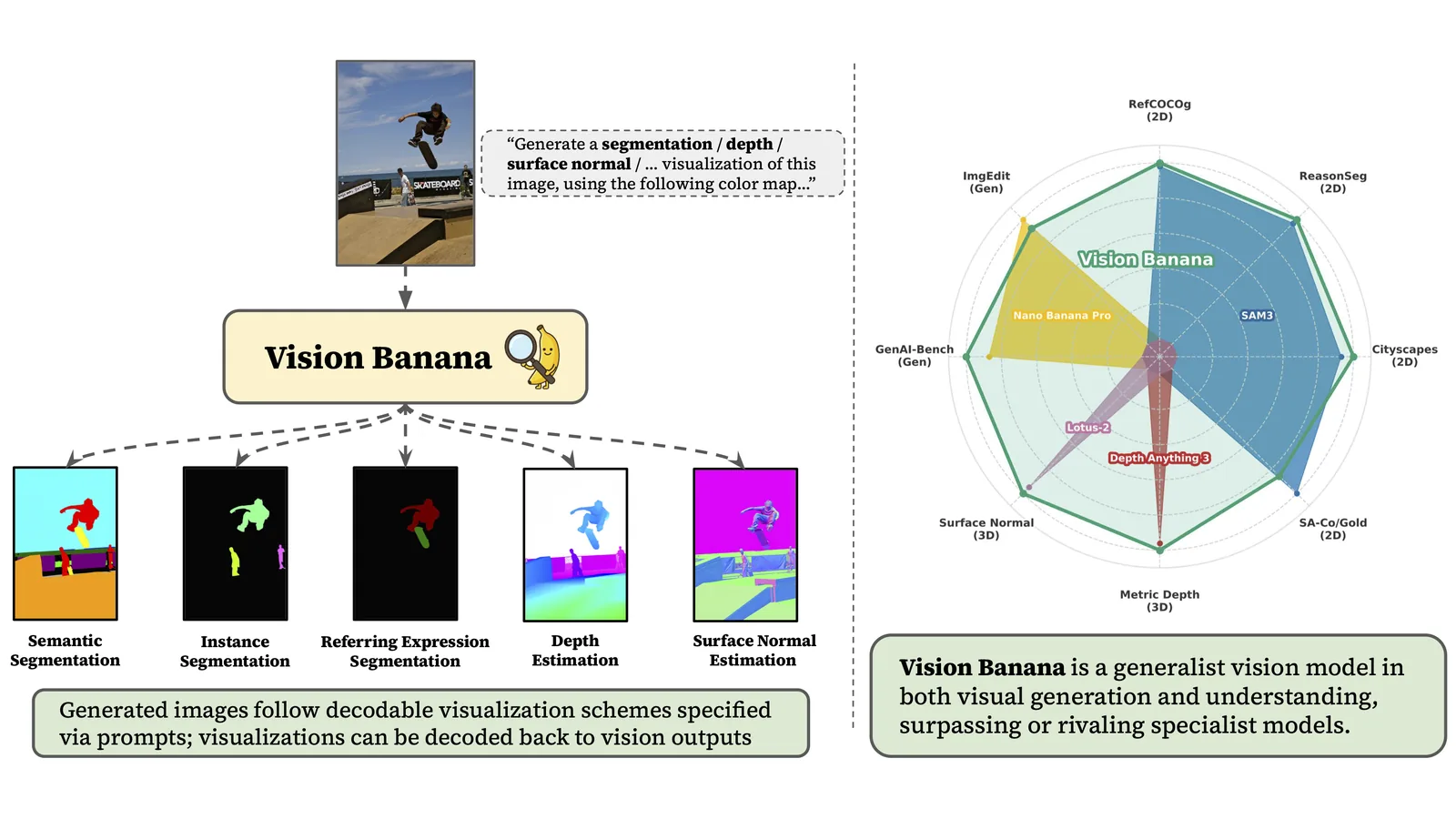
Vision Banana is Google DeepMind work released in April 2026. Technically it is remarkably economical: take Google’s own image generation model, Nano Banana Pro (NBP), as the base, run instruction tuning on a small amount of vision-task data, and a model built only to make pictures comes out able to perceive as well.
Figure 1: A sketch of Vision Banana’s core idea. On the left, the image generation capability Nano Banana Pro already had; on the right, the visual understanding capabilities that emerge after instruction tuning — semantic segmentation, instance segmentation, referring expression segmentation, depth estimation, surface normals and more. The paper’s core belief is that generative pretraining on its own teaches a model powerful general visual representations, just as next-token prediction does for LLMs.
Its most elegant design move is to give every vision task the same output parameterization: an RGB image.
- Semantic segmentation? Output a colored mask.
- Instance segmentation? Output an image with each instance painted a different color.
- Monocular depth? Output a rainbow-encoded depth map.
- Surface normals? Output an image encoding normal directions.
One concrete example shows how this works in practice:

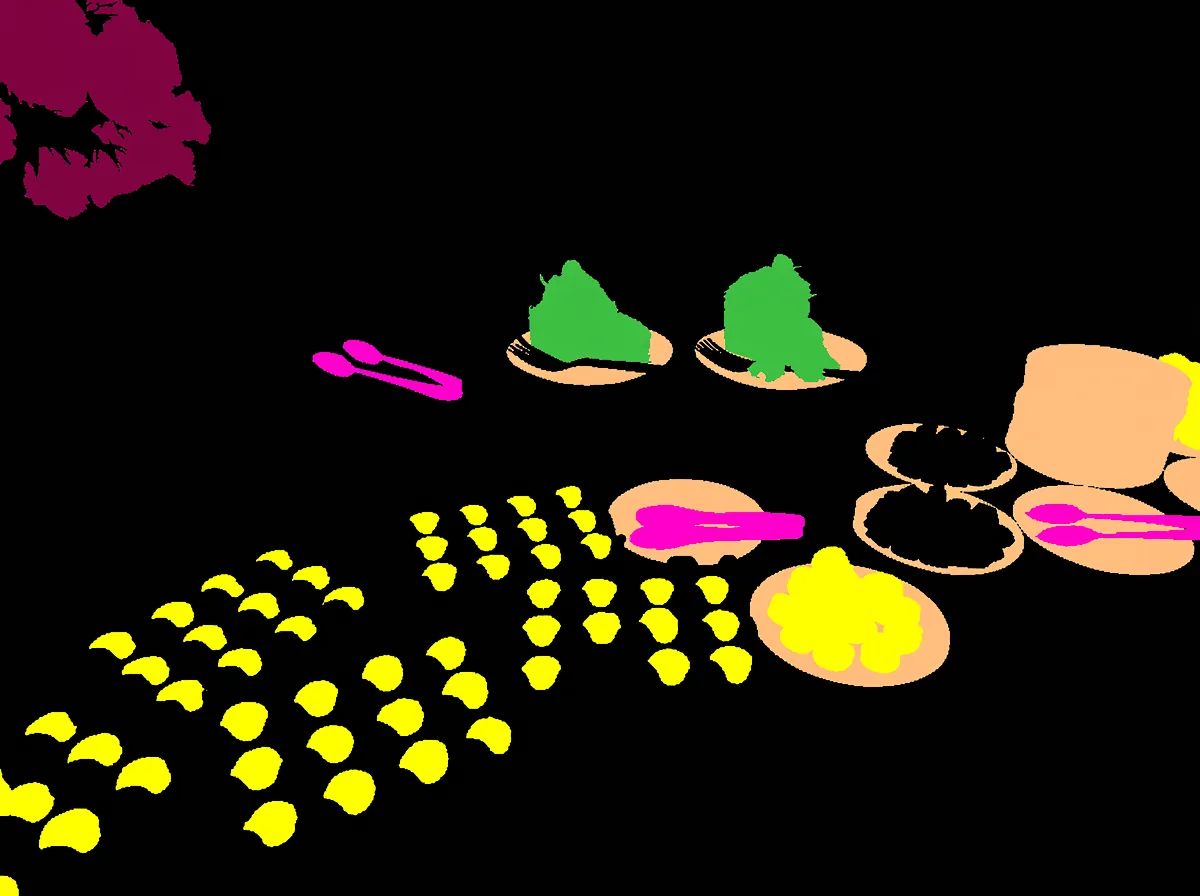
Figure 2: Semantic segmentation executed in context. Given a photo of macarons and desserts (top) and a natural-language instruction — “macarons in yellow, the round plate in light orange, the cake slice in green, the flowers in purple, the tongs in pink” — the model simply “paints” a segmentation map colored strictly by those rules (bottom). The output space of vision tasks is rebuilt wholesale as a conditional image generation problem. This is the single most important design decision in the paper.
What does that buy? Under zero-shot transfer, Vision Banana beats SAM 3 on Cityscapes semantic segmentation, beats the Depth Anything family on the average of six monocular metric depth benchmarks, and beats the SAM 3 + Gemini 2.5 Pro combination on referring expression segmentation. Put plainly: a generative model, lightly tuned, beat purpose-built SOTA systems on multiple visual understanding tasks.
The same architecture switches seamlessly to 3D perception:
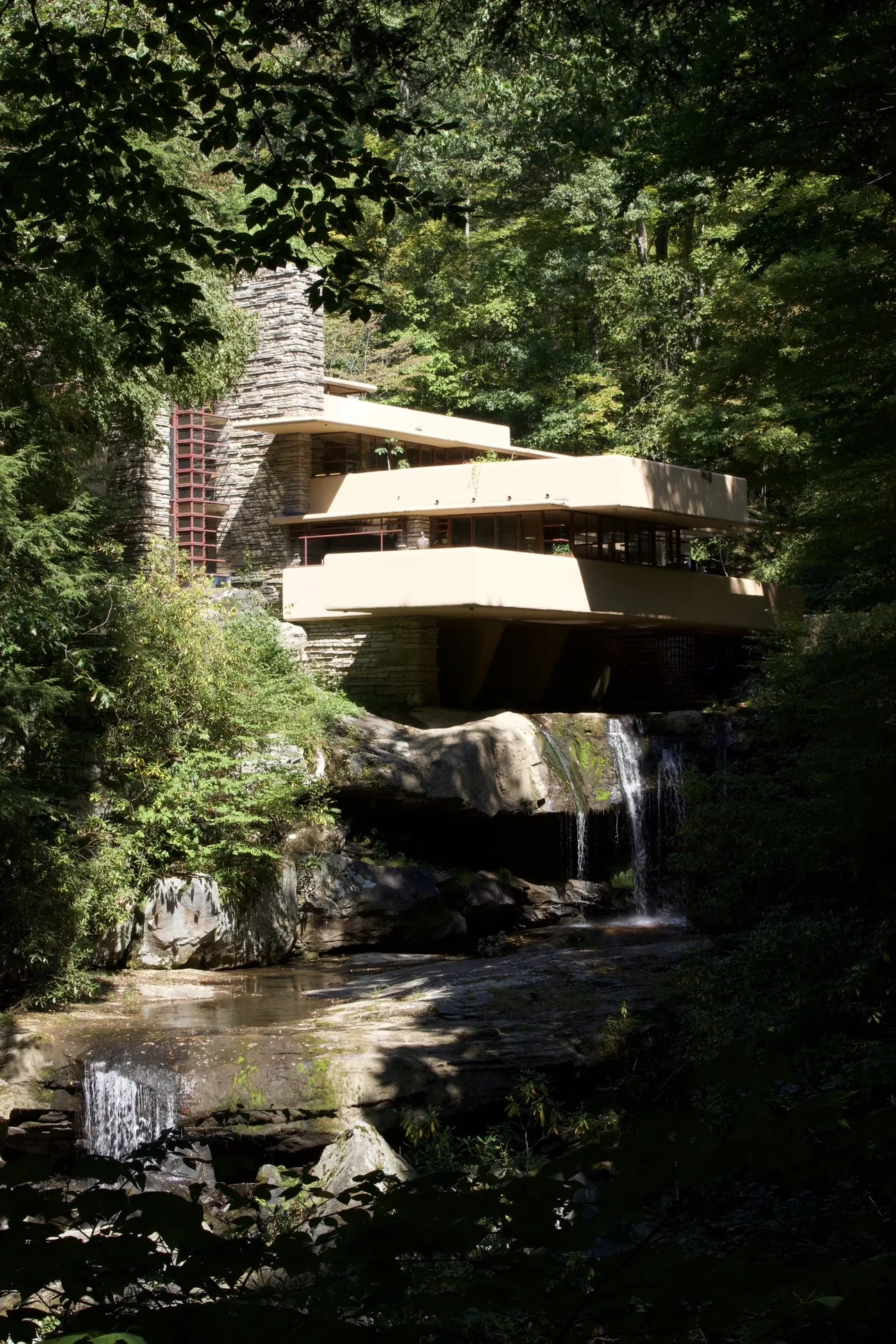

Figure 3: Depth estimation. Given a photo of Frank Lloyd Wright’s Fallingwater (top), the model generates a rainbow-encoded metric depth map directly (bottom; near → far = red → purple). Vision Banana was never trained specifically on this kind of architecture-in-landscape scene, yet it produces a high-quality 3D perception result zero-shot. This is the most persuasive evidence in the whole paper — it shows that the representation learned through generative pretraining doesn’t just “know how to paint”; it has internalized a general grasp of three-dimensional geometry.
The core author team is Valentin Gabeur, Shangbang Long and Songyou Peng, with Saining Xie and Kaiming He listed as Leadership Sponsors — two of the most influential figures in contemporary vision research. The byline alone says how seriously Google DeepMind takes this path.
The paper’s central claim fits in one sentence: image generation training and LLM pretraining play equivalent roles; both teach a model powerful general representations. It is an elegant analogy. It is also the paper’s most ambitious and most contested claim.
2. Precise Anchoring on the LLM Timeline
Calling Vision Banana “vision’s GPT moment” or “the dawn of vision unification” points the right way, but the analogy isn’t precise enough. To see where it really sits, cut the LLM development path into five key leaps:
First leap (2017, Transformer): architectural unification; the RNN era ends.
Second leap (2018, BERT vs GPT): the route debate between discriminative and generative pretraining. BERT clearly had the upper hand from 2018 to 2020.
Third leap (2019, T5): interface unification. T5’s thesis was “every NLP task is text-to-text” — translation, question answering, summarization, classification, all rewritten as generation problems.
Fourth leap (2020, GPT-3): emergence at scale, and the end of the route debate. A 175B-parameter purely generative pretrained model crushed task-specific systems in zero-shot and few-shot settings; the generalist beat a whole field of specialists. The generative camp won.
Fifth leap (2022–2023, InstructGPT → ChatGPT): instruction tuning plus RLHF, turning the “generator” into an “assistant.” The key step from technical breakthrough to product form.
Map vision’s milestones onto these one by one:
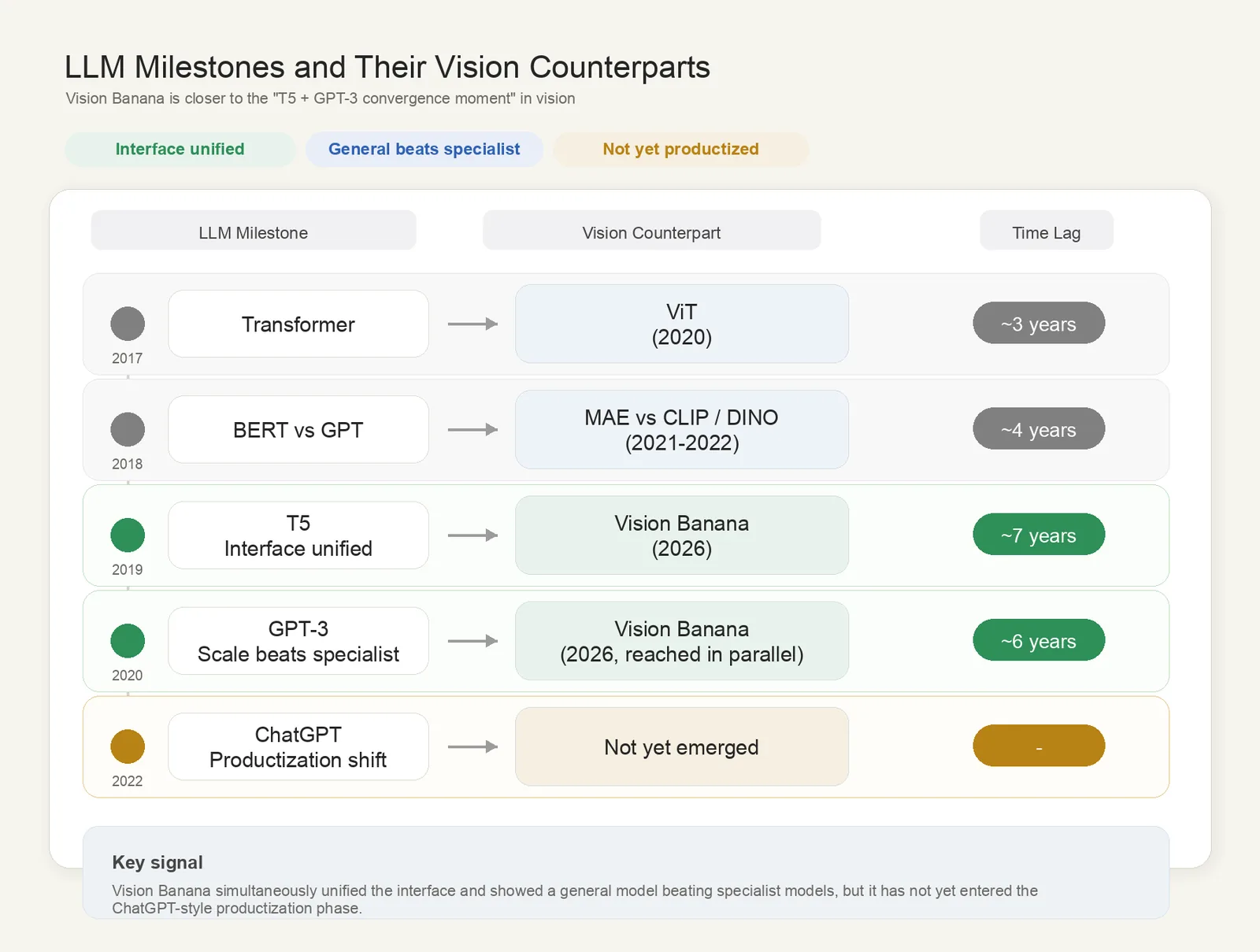
Two things fall out of that table.
First, Vision Banana is vision’s “T5 + GPT-3 combined moment.”
It delivers at once two things that happened separately in NLP: T5-style interface unification (“everything is image-to-image”), and GPT-3-style generalist-beats-specialist (zero-shot wins over SAM 3 and Depth Anything). In NLP those two events were a year apart; in vision they happened in one go.
Second, Vision Banana is still not vision’s ChatGPT moment.
ChatGPT’s real breakthrough was product form — non-experts could use an LLM through ordinary conversation. Vision Banana uses instruction tuning, but what it delivers is still numbers on benchmarks. It hasn’t crossed the product boundary and it hasn’t produced ecosystem-level change. Vision’s ChatGPT moment hasn’t arrived.
Why this anchoring naturally evokes “the dawn of unification”
That public discussion reads Vision Banana as “the dawn of vision unification” isn’t baseless — it has a hard logical root.
GPT-3 was the true paradigm-level event in LLM history because it used one general generative model to beat expert models trained separately for each of many downstream tasks. T5’s interface unification plus GPT-3’s generalist-beats-specialist, chained together, unlocked every downstream narrative that followed — instruction tuning, RLHF, ChatGPT, agents — all of it resting on the fact that one general generative model is enough for everything.
Vision Banana is, in form, almost a mirror image of that moment: one general image generation model, with a small amount of instruction tuning, beat purpose-built SOTA systems on multiple visual understanding tasks. LLMs took this step and then locked in the paradigm of “next-token prediction unifies everything.” Will vision take the same step and then settle into “image generation unifies generation and understanding”?
That is a natural linear extrapolation, and not an unreasonable one — not the fantasy of enthusiasts but rational pattern-matching on LLM history. People expect “unification” in vision precisely because the LLM path supplied an unusually clear template.
But pattern-matching is only as reliable as the correspondence of the underlying conditions. Before asking whether the extrapolation holds, a short detour to settle one question: why did vision need 4–5 years longer than NLP to reach this step? The delay itself carries information.
3. One Layer Deeper: Why Vision’s “BERT vs GPT” Debate Dragged On So Long
This deserves a few more words, because it goes to the essential difference between vision and language.
In NLP, BERT held the upper hand over GPT for roughly 1–2 years before GPT-3 settled the matter decisively. In vision, the discriminative route that CLIP represents dominated the generative route for a full 5 years. The reason isn’t that vision researchers were any less smart. Three properties of the visual modality itself delayed the generative camp’s win:
First, images carry far less information density than text. LeCun has hammered this point for years. Predicting a token compresses semantics; predicting a pixel may only synthesize texture. So the “emergence of understanding” from generative pretraining is weaker in vision than in NLP, and shows up later.
Second, path dependence in downstream evaluation. CLIP’s zero-shot classification benchmarks are easy to run and easy to spread; the advantage of generative pretraining only shows on dense prediction tasks, where evaluation costs an order of magnitude more. The community’s attention followed the easy benchmarks.
Third, a generational gap in training cost. Pretraining a diffusion model costs an order of magnitude more than a discriminative one. The CLIP camp captured the returns to scale first; the generative camp only got matching compute in the past two years.
Vision Banana ends this route debate with a single experimental result: the generative camp has won in vision, 4 years after it won in NLP. The verdict came late, but it carries the same weight.
4. “Unifying Generation and Understanding” Has to Be Taken Apart
Back to the question left hanging at the end of Part 2: LLMs settled generation and understanding into one paradigm through a general generative model — will vision walk the same road?
Follow the academic and industrial record of the past two years closely and you run into a counterintuitive fact: architectural unification of generation and understanding is neither the direction the academic mainstream is sprinting toward nor the architecture the industrial mainstream is shipping. Vision Banana’s release pushed the proposition back into the spotlight, but in serious research and engineering practice it matters far less than the public conversation would suggest.
The academic mainstream is exploring more differentiated paths, not more unified ones
A quick scan of the weightiest lines of work over the past 18 months:
- Kaiming He’s MAR and l-DAE series move away from pure diffusion toward autoregression on continuous tokens. What they care about is “which inductive bias suits vision best,” not “how to make generation and understanding share one set of parameters.”
- Yann LeCun’s JEPA series (I-JEPA, V-JEPA) flatly rejects the equation “pixel-level prediction equals understanding,” arguing for more efficient representation learning in a joint embedding space — anti-“unification” at its core.
- Meta’s Transfusion, DeepSeek’s Janus, the Tsinghua-linked Show-o: these sound like “unified architecture” work, but internally they still split the work between a generation head and an understanding head, sharing parameters only in the Transformer trunk. Closer to “one body, two brains” than “one brain doing two jobs.”
The real consensus among top researchers is not “pursue architectural unification” but “find the representation with the right inductive bias.” Unification is a possible by-product, not the goal.
The industrial mainstream isn’t building “unified architectures” either
Industrial practice is even more telling. None of today’s AI products with real user scale is architecturally a unified model:
- Claude, GPT-4 and Gemini are, at bottom, modular combinations of an LLM brain + a vision encoder + tool calling.
- Mainstream VLA (vision-language-action) architectures in embodied AI are all three-stage: vision encoder + LLM + action head — Physical Intelligence, Google’s RT-2, ByteDance’s GR series, without exception.
- The robotics stack is more fragmented still: perception stack, planning stack, control stack, each with its own model choice.
This isn’t a temporary state; it’s the engineering optimum. Modularity’s hidden advantage is that each module can be iterated, swapped and verified independently. When the best vision encoder, the best LLM and the best action model are each led by different teams, the system that can assemble the best modules fastest beats the system that bet on a single unified architecture.
Real market demand has almost nothing to do with “unification” either
Downstream users are almost entirely indifferent to whether the architecture is unified:
- A designer needs “generate good images + edit precisely.” She doesn’t care whether both come from the same model.
- A robotics company needs “accurate perception + sensible planning + stable execution.” They actively prefer different models for different stages, because a safety-critical system needs every component to be independently verifiable.
- A video production company needs “cinema-grade generation + controllable editing.” Whether one model or three chained together sit behind it is beside the point.
What the market really wants is “every capability good, and efficiently composable.” That is a different technical goal from “unification at the architecture level,” and current industrial practice is clearly betting on the former.
So what does NTP-style “unification” actually mean in LLMs?
Back to the source. LLMs achieved “generation and understanding are the same thing” not merely because they “use the same loss function,” but because of an innate property of the language modality: human language is already a compression of meaning, so predicting the next token is, by nature, learning a compressed representation. Visual data has no such property. In a natural image, most pixel variation carries low-level signal — texture, lighting, noise — only weakly tied to semantic understanding. Forcing a model to predict those pixels precisely does not automatically mean it is learning to understand.
So transplanting “the NTP unification of LLMs” directly onto vision is symmetric in form and mismatched in substance. This is the classic trap of mistaking formal similarity for essential similarity. I fell into it myself early on, which is why I’m flagging it separately.
At what level does “unification” still have value?
It isn’t worthless. The more precise judgment is layered:
- On L1 tasks (recognition, classification, retrieval): unification is unnecessary; modularity is good enough.
- On L2 tasks (multimodal editing, dialogue, content generation): unification helps somewhat but isn’t decisive — GPT-4o and Gemini 2.5 aren’t truly unified architectures either.
- On L3 tasks (embodied AI, world models, agent-level planning): unification may be the real necessity, because these involve the deep, tight coupling of “imagining the manipulation trajectory while looking at the scene.”
So the more precise conclusion: if you bet on “unification,” bet on it in the specific scenario of integrated perception–planning–execution for embodied AI, not as a general proposition about vision foundation models. Vision Banana’s real contribution isn’t proving that unification is the future. It’s showing that the representational power of generative pretraining has been badly underrated for years — a solid conclusion, and one that sits comfortably alongside modular architectures.
5. Where the Industrial Opportunity Actually Is
Take “unification” apart and the industrial picture for vision foundation models gets much clearer. My judgments:
Judgment 1: Generative backbones will crowd out CLIP-style discriminative backbones
This is Vision Banana’s real industrial implication — not “unification,” but that the backbone selection logic for vision foundation models has to be redone. For the past several years, the default vision stack at robotics, embodied AI and autonomous driving companies has been CLIP + task head. In the next 2–3 years it will most likely be replaced by generative backbones. That is a concrete, observable technical migration.
What it means in practice: the question to ask of any company in this space is whether it sees the migration coming and has the technical path and the people to switch fast. Teams still digging deeper into the CLIP + task-specific-head paradigm face not an incremental optimization problem but a structural obsolescence risk.
Judgment 2: Vision’s ChatGPT moment hasn’t come, and RLHF won’t be the trigger
Many people expect a “Vision RLHF”-style alignment result to set off product-level change in vision. I am openly skeptical.
The three conditions underlying RLHF’s success in NLP all fail in vision: cheap annotation of human preferences, one-dimensional comparability of those preferences, and describable failure modes. Vision models’ failure modes — six-fingered hands, blurred semantic boundaries, violations of physical consistency — are mostly structural, and hard to correct through natural-language feedback.
What will actually trigger vision’s ChatGPT moment, in my judgment, is the confluence of three elements:
- Vision agents’ reasoning scaffold matures — vision models get called as agent components, not single-shot predictors.
- Feedback from the physical and digital world replaces human preference — robot grasp success or failure, agent task completion or failure. These binary signals are free and objective.
- World models provide the simulated training ground — not as a perception base, but as the supplier of RL environments.
Only when those three converge does vision’s ChatGPT moment really arrive. The rough window is 2028–2030 — somewhat longer than the 2.5 years LLMs took from GPT-3 to ChatGPT, because physical feedback and world-model infrastructure still have to be built.
Judgment 3: A concrete question for evaluating a vision AI team
Taking “unification” apart yields an interesting by-product: it turns into a concrete screening question. Sit across from a vision AI team and ask: “How do you think about unifying generation and understanding?”
Three typical answers mean completely different things:
- Dogmatic embrace: “Unification is the inevitable direction; we’re building a unified architecture too.” — Chasing a narrative amplified by public discussion, not making a product judgment.
- Flat denial: “That’s an academic pseudo-problem; we only do modular composition.” — Blind to the genuine need for deep coupling in embodied scenarios.
- Clear layering: “Unification isn’t necessary in our current product form, but if we move to L3 scenarios we’ll re-evaluate.” — Teams like this are worth digging into, because their technical judgment is layered and grounded.
Turning a seemingly grand technical proposition into a concrete evaluation question is the most practical by-product of “taking it apart.”
6. A Layered Way of Judging
Finally, how to hold work like this.
The pursuit of architecture and the next AI paradigm has a natural intellectual appeal — paradigm evolution after the Transformer, world models, VLA, diffusion to autoregression, REPA to RAE. The intellectual pull of this work is hard to resist.
But for industrial judgment or capital allocation, you have to keep the layers apart:
- The main logic of industrial deployment should be realist: foundation models are the hyperscalers’ long game, and what really decides whether AI can go deep into the messy physical world is not the model itself but foundational software, software-engineering discipline and system-level integration.
- Intellectual exploration is another layer. Keep tracking it, keep thinking about it, but not every intellectual thrill has to turn into a concrete bet.
Vision Banana’s significance sits exactly at the seam between those layers. As a piece of work it deserves a serious read; as a signal it deserves serious tracking; as a topic on its own it should not monopolize attention.
What is truly worth betting on is not the abstract proposition of “unifying generation and understanding” but the deeply coupled architecture of next-generation embodied AI, and who gets generative backbones into industrial-grade robot perception stacks first. Those two questions will generate more industrial opportunity than “unification” ever will.
That is also the theme I keep coming back to: vision is not a standalone modality; it is the window onto the world. The real value of the next generation of vision foundation models lies not in how elegant the architecture is, but in whether it can carry an agent’s understanding, prediction and action in the physical world.
The judgments here will be revised as new evidence arrives. Comments and pushback welcome.