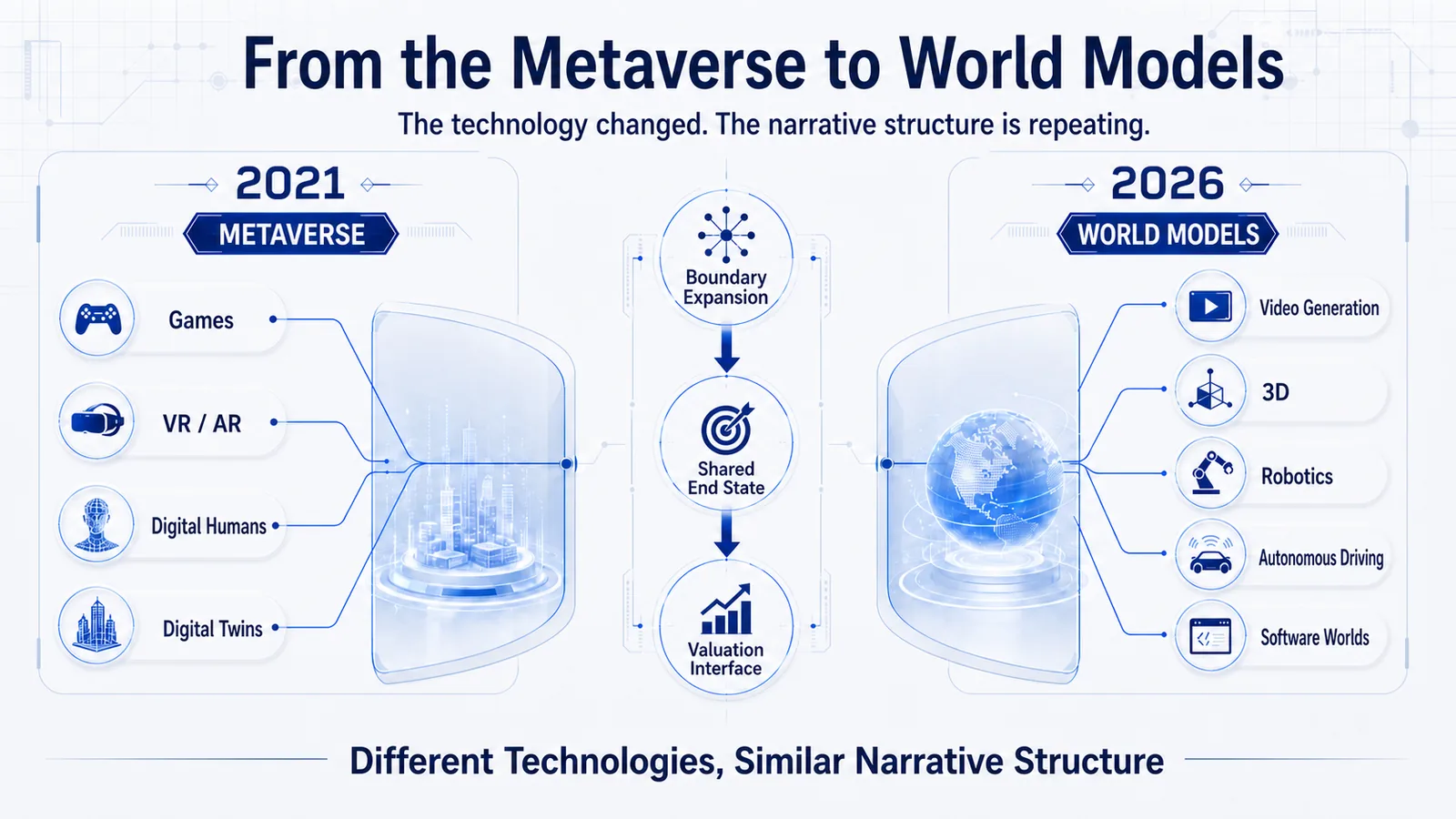
From video generation and 3D reconstruction to robotics and software, very different technologies are being placed inside the same “world model” category.
Watching the world-model sector lately often feels like being transported back to 2021.
That was the year Facebook renamed itself Meta and declared that it would become a “metaverse-first” company. Before long, games, VR, AR, digital humans, 3D engines, digital twins, NFTs, industrial software, and even online meetings could all be placed inside the metaverse frame. The technologies were real, and each industry had value of its own. Yet adding “metaverse” to the first page of a pitch deck suddenly gave a collection of unrelated businesses the same grand destination, the same trillion-dollar market, and a new industry identity. Facebook became Meta on October 28, 2021.
The phrase “metaverse-first” appeared in Zuckerberg’s founder’s letter published that day.
Five years later, a similar pattern is returning—at least in the way capital markets organize a narrative.
Video-generation companies say they simulate the world. 3D companies say they generate it. Autonomous-driving and robotics companies say they predict the physical world. Game companies say they create interactive worlds in real time. Enterprise data, browsers, and product workflows are now being described as “software worlds.”
If the last cycle favored the words Meta and Metaverse, this one favors World and Cosmos. NVIDIA’s platform, launched in 2025, is called Cosmos. It is not a single model but a physical-AI toolchain spanning generative models, video processing, visual tokenization, guardrails, and data pipelines.
The naming parallel is only a coincidence; there is no evidence that Cosmos was meant to imitate Meta. But the taste for cosmic language says something about the market’s preferences: the larger the concept and the less precise its boundary, the easier it becomes to place different capabilities, stages, and business models inside one picture of the future.
World models are not an invented idea, and they may well become part of the foundation of the next generation of intelligent systems. What is changing is their status. A technical direction is becoming an elastic industry category, with rendering, simulation, planning, and the long-term ambition of physical AGI increasingly sharing the same name.
Where Does a World Model Begin and End?
The fact that video, 3D, robotics, and software companies all use the term “world model” does not by itself constitute misuse.
In the tradition of model-based reinforcement learning, a “world” has never had to mean the entire physical universe. It can be a game map, a stretch of road, a robot workcell, or a browser and phone interface. If an environment has state and transition dynamics, and a model can predict how that environment evolves, it may qualify as a kind of world model. Ha and Schmidhuber’s influential 2018 project, World Models, trained an agent to learn a compressed representation and temporal dynamics of its environment, then trained a policy inside an internal “dream.”
A software world model is therefore not inherently less legitimate than a robotic one. Alibaba’s AutoNavi team built Code2World, which generates the next interface from the current screen and actions such as clicks or swipes, then uses those predictions for agent planning. Qwen’s WebWorld explicitly models “page state + browser action → next page state.” Their worlds are narrow, but their states, actions, and validation objectives are clearer than those of many products advertised as understanding the physical world.
Nor should video generation be excluded by definition. Internet video can teach a model priors about object permanence, spatial relationships, and what the future should roughly look like. Meta’s V-JEPA 2 was first self-supervised on more than one million hours of video without actions, then trained as an action-conditioned predictor using 62 hours of robot data. Meta reported a 65–80% success rate on robotic pick-and-place tasks in unfamiliar environments. This is early closed-loop evidence that “learn from video first, then add action” is more than a story.
Those figures come from Meta’s own experiments. They are not equivalent to third-party reproduction or deployment at scale.
Confusion enters when technical communication compresses the sequence. “This could become part of a world model” quickly turns into “we have built a world model that can plan, control, and generalize.” A path toward an end state is presented as a capability already delivered.
In June 2026, World Labs itself acknowledged that “world model” had become one of the most important and overloaded terms in AI. A beautiful but physically impossible video, a temporarily generated playable game, and a rigorous physics engine can now share the same label. The company’s functional taxonomy is useful: a renderer outputs pixels, a simulator exposes computable world state, and a planner produces actions.
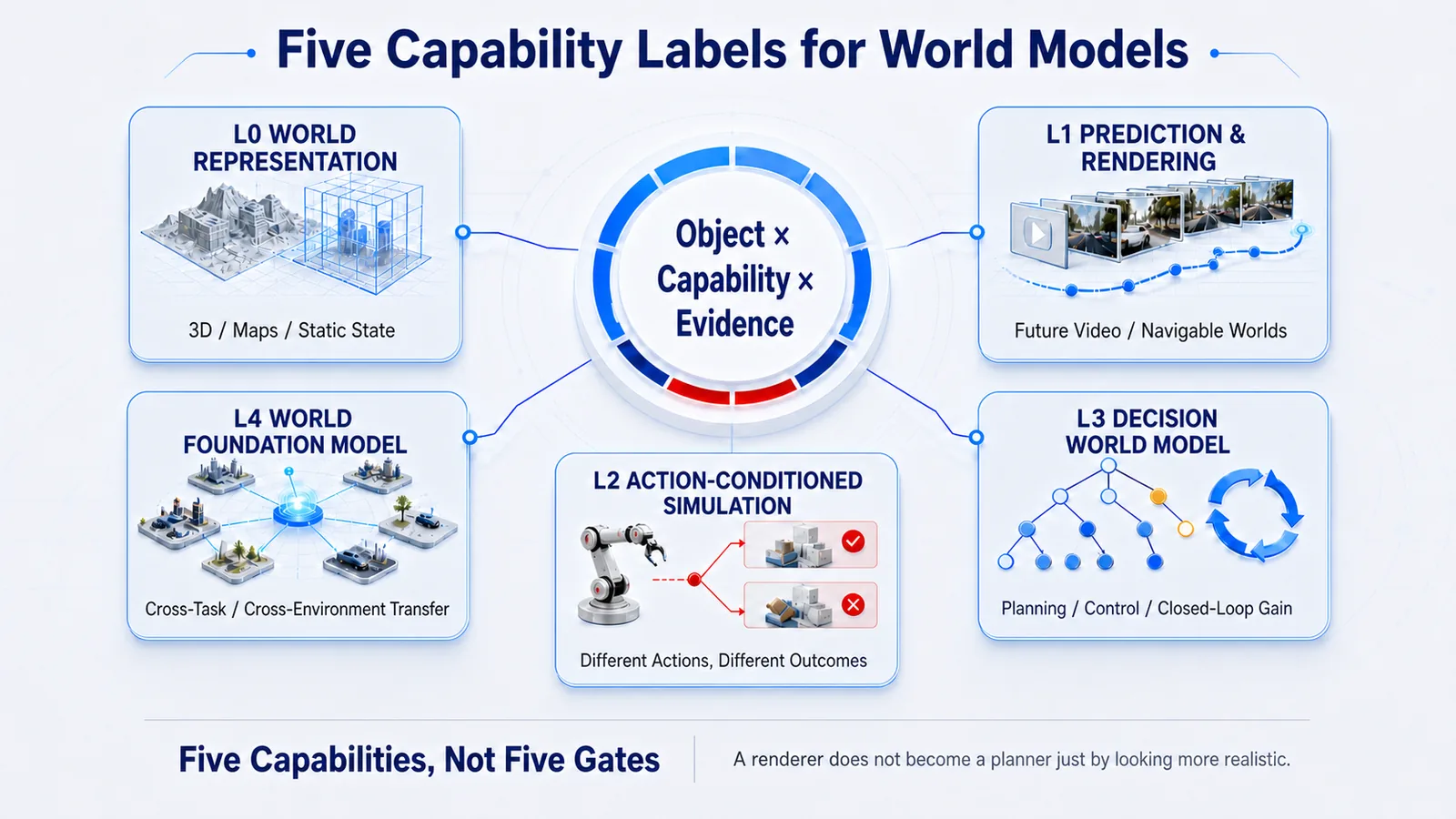
To see what different teams are actually building, it helps to use five functional labels:
| Label | What the model actually does | A more appropriate test |
|---|---|---|
| L0 World representation | Reconstructs maps, 3D scenes, object relations, or static state | Geometric accuracy, persistence, editability |
| L1 Prediction and rendering | Generates visually plausible future video or navigable worlds | Long-horizon consistency, object permanence, visual quality |
| L2 Action-conditioned simulation | Predicts different consequences from the same state under different actions | Action adherence, causal fidelity, counterfactual accuracy |
| L3 Decision world model | Uses internal rollouts to evaluate policies, choose actions, or assist control | Policy success rate, simulation-to-reality ranking correlation, closed-loop gain |
| L4 World foundation model | Transfers across tasks, environments, and embodiments | Cross-domain generalization, few-shot adaptation, reliability at scale |
This is not an academic standard, nor is it a staircase every model must climb in order. A latent-space planner may never need to produce photorealistic video; an excellent renderer may remain at L1 indefinitely. The numbering simply marks what capability a company claims and what evidence should support that claim. L0 and L1 can become foundations for L3 and L4, but a foundation, an architectural rendering, a model home, and a functioning city are still different things.
Between a Better Next Frame and a Useful Next Action
Video generation is particularly easy to rebrand as a world model because its demonstrations are immediately legible.
In 2024, OpenAI titled the Sora technical report “Video generation models as world simulators”. The report itself was considerably more measured. Scaling video-generation models, it said, was a “promising path” toward general-purpose simulators of the physical world. The same report acknowledged that Sora could not accurately simulate breaking glass or the changed state of an object after it had been eaten, and that long videos suffered from incoherence and objects appearing spontaneously.
Industry retellings often preserve only the first half: video models are becoming world simulators. The second half—that they do not yet possess reliable physical causality—quietly disappears.
Runway once described Gen-2 as a “very early and limited” form of a general world model. It also wrote that a genuine world model would need a consistent map, navigation, interaction, and the dynamics of other agents in the environment. Those qualifications appeared in a 2023 research note. By 2026, Runway had moved a step further. It let eight robot policies act continuously inside observations generated by GWM-Robotics, compared the results with physical-robot outcomes, and reported a policy-ranking correlation of 0.95. The experiment covered only one robotic arm and tabletop tasks, so it did not establish general robot control. But it began to answer a genuinely useful question: can this model help an engineering team screen policies?
The 0.95 figure is a Pearson correlation coefficient reported by Runway. It remains a company result, not an independent validation.
Taken together, these examples show where the boundary lies.
A model may produce no beautiful video and still sit close to the core of a world model because it improves planning. Another may generate a spectacular world yet have no reliable account of what a particular action will cause. Visual fidelity and causal correctness are different capabilities.
Several public interviews I revisited recently point in the same direction. Xiaomi researcher Chen Long divides industry usage into broad and narrow definitions. The broad version can include 3D reconstruction, video generation, autonomous driving, and World Action Models. He is more interested in predicting the “next essential state” than in rendering how every leaf moves in the next frame. Embodied-AI founder Huang Qingqiu is similarly reluctant to discuss everything through one large term. The better questions, he argues, concern how a model is trained, where it is used, and whether it provides supervision, offline simulation, or online exploration. The two interviews are available here and here.
Chen Long’s position is also summarized in this written interview.
The industry understands these distinctions. The first page of a funding deck rarely has room for all of them.
Why World Models Became a Funding Magnet in 2026
Why did the term become a funding magnet in 2026?
As competition in general-purpose foundation models concentrates among a small number of giants, world models have become one of the few remaining labels capable of carrying both immense compute requirements and a vast end-state narrative. The category connects video, games, robotics, autonomous driving, and agents. Its potential market can expand almost without limit, and it can readily be presented as “the next generation of AI after language models.”
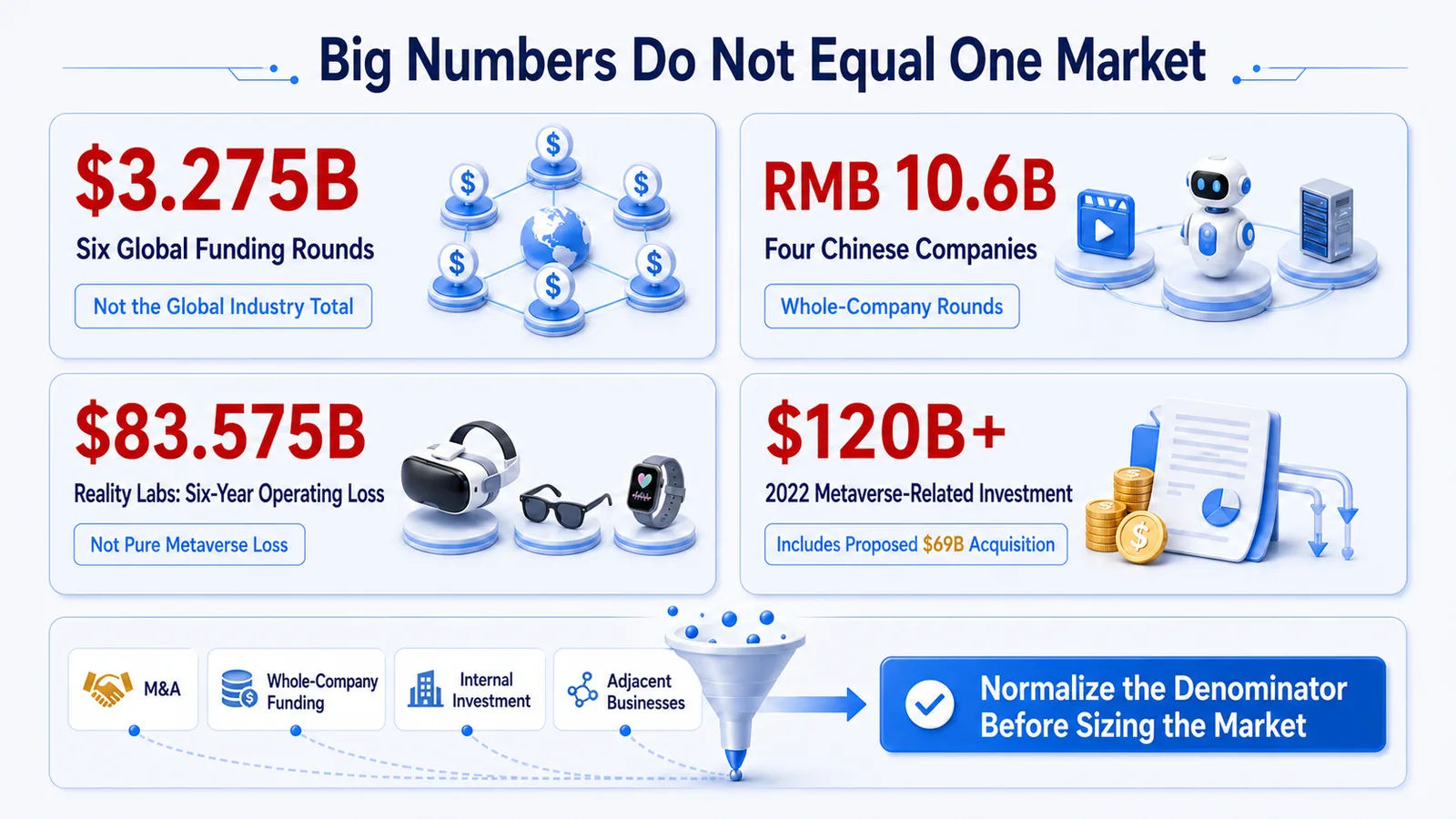
A rough sum of six disclosed rounds in the first half of 2026—at companies that put world models at the center of their narrative or research agenda—comes to $3.275 billion: World Labs, $1 billion; AMI Labs, $1.03 billion; Runway, $315 million; Decart, $300 million; General Intuition, $320 million; and Odyssey, $310 million. This is an arithmetic total of several identifiable transactions, not the total financing of a global industry. It excludes autonomous-driving companies and internal spending by technology giants.
AMI Labs is the clearest example. The company raised $1.03 billion before releasing a product, while management still described it as a fundamental-research project. Le Monde reported at the time that it employed roughly ten people and expected practical applications to take several years. Even more revealing was CEO Alexandre LeBrun’s prediction: within six months, every company would call itself a world-model company in order to raise money.
Both the comment and the $1.03 billion round were reported by TechCrunch.
There is a clear technical reason for this financing sequence. Frontier foundation models require compute, scarce talent, and long research cycles. Capital often has to arrive before the product is mature. What is being priced is not present revenue but the probability that a technical route becomes the next computing platform.
In communication and fundraising, however, that long path is often compressed through three moves:
- Narrative upgrade. Video generation, 3D reconstruction, simulation tools, and policy models are grouped under “world models,” giving vertical products the imaginative scope of a foundation model.
- Evidence compression. Papers, leaderboards, short demos, single-scene physical tests, customer pilots, and scaled deployment are six different stages. They are often blended into the impression that industrialization has already occurred.
- Timeline pulled forward. Today’s renderer, data tool, or evaluator begins to carry the value of tomorrow’s general planner or physical AGI.
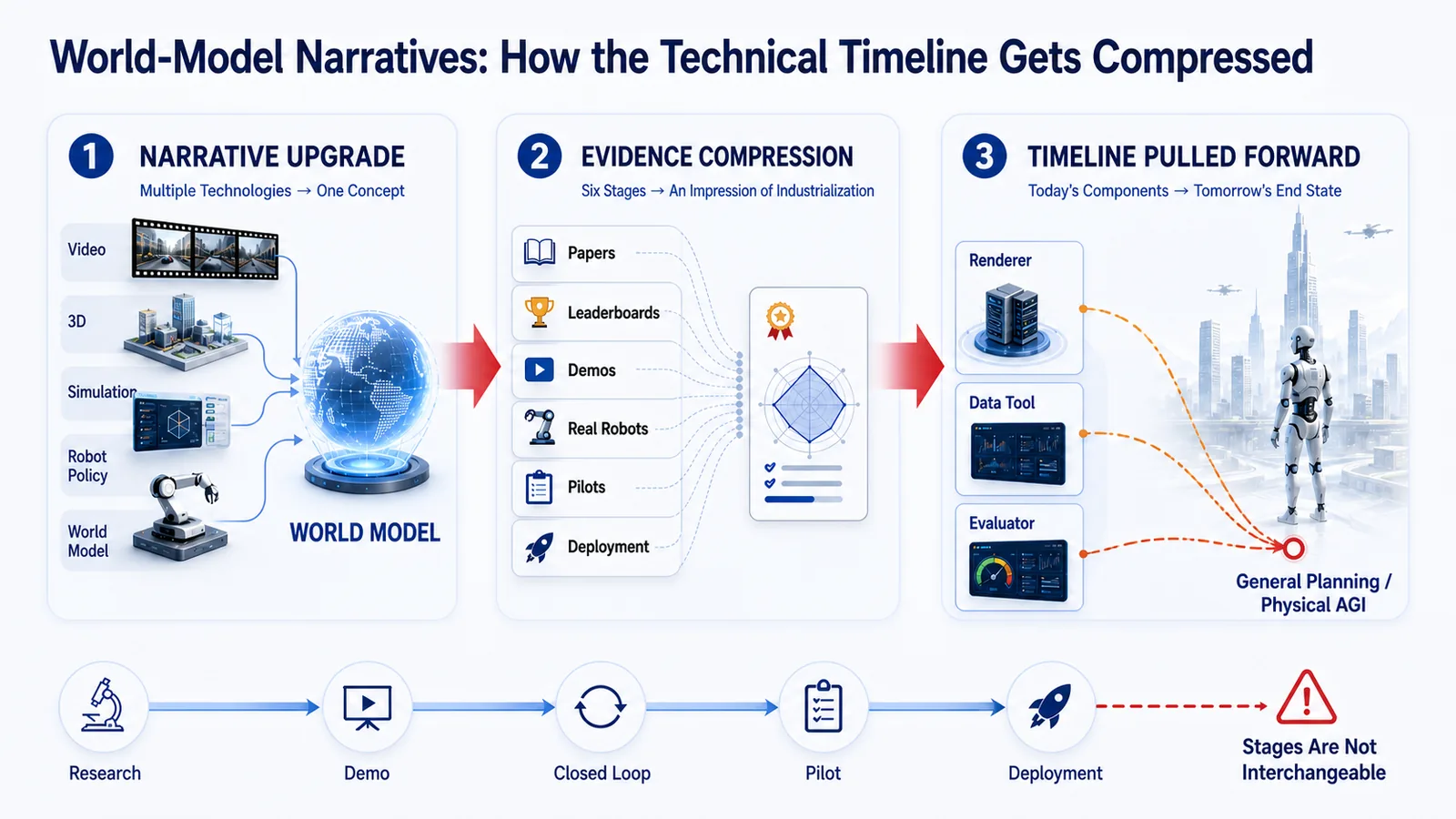
Technical progress, industrial direction, and funding intensity can all be real at the same time. They simply unfold on different clocks.
In Parts of China, Funding Is Moving Faster Than Public Validation
The Chinese market is more complicated. The country has substantial engineering depth in video, robotics, and autonomous driving. At the same time, “world model” is rapidly becoming one of the most valuable labels on a fundraising deck.
Using the amounts stated in public funding announcements, HiDream.ai disclosed more than RMB 2.1 billion within three months; ShengShu Technology raised nearly RMB 2 billion in its Series B; GigaAI disclosed three rounds totaling RMB 3.5 billion within roughly three months; and Galaxea AI’s Series B and B+ totaled approximately RMB 3 billion. Together, those company-level rounds amount to roughly RMB 10.6 billion. Public disclosures are available for HiDream.ai, ShengShu Technology, GigaAI, and Galaxea AI.
These are entire company rounds. The proceeds also fund video products, robot hardware, data collection, compute, and commercialization. The figures show that some companies using the world-model narrative are raising large sums in rapid succession. They do not constitute a clean measure of a “Chinese world-model market.” Before the category itself has stabilized, any aggregate must be read alongside its denominator and the actual uses of capital.
The sequence matters more than the amount.
According to Caixin, Manifold AI completed six funding rounds in roughly its first year. LiberAI was founded in December 2025 and had completed four rounds by June 2026. Soon after an angel-plus round of about RMB 500 million, it closed another pre-Series A worth several hundred million renminbi. At the same time, the company said that a key objective for the coming year was to conduct joint validation with robotics and autonomous-driving companies. Reporting on Manifold AI and LiberAI’s funding timeline exposes a visible mismatch: capital is already pricing the company repeatedly, while externally verifiable, scaled industrial validation remains sparsely disclosed and joint validation is still a future priority.
The pattern of category expansion differs from company to company.
Based on public papers and product materials available by the research cutoff, HiDream.ai’s technical evidence is concentrated in image generation, video creation, and content agents, including 2026’s HiDream-O1-Image. Its fundraising materials, meanwhile, describe a “native omni-modal world model.” Moving from content generation to action-conditioned dynamics and downstream decision-making still requires a further layer of validation. ShengShu Technology has two distinct tracks. Its Vidu video business sits within a “digital world model” framework, while Motus and Motubrain genuinely introduce action, inverse dynamics, and robot policy. The code and weights for Motus are public. Content generation and action modeling coexist within one company, but they are not at the same level of maturity and should not be judged by the same metrics.
GigaAI has released papers, models, and company-reported physical-robot experiments. What can currently be confirmed is research progress and limited-scene validation. Papers, leaderboard positions, a single-factory pilot, plans for thousands of robots, and “physical AGI” still belong to different timelines. The WorldArena benchmark, in which its model was evaluated, also shows that high visual quality does not necessarily translate into downstream functional value. The technology can continue improving while deployment at scale still requires a much longer run of evidence.
XPeng and NIO illustrate a different path into product feedback loops. According to XPeng, X-World takes historical multi-view video and candidate driving actions, generates the corresponding future scenes, and supports closed-loop simulation, online reinforcement learning, and data generation for its second-generation VLA. NIO has begun rolling out a new version of NIO WorldModel to more than 460,000 vehicles equipped with its Banyan system. The number comes from a NIO company announcement. It does not by itself prove a safety improvement, but it does show that the capability has entered a production system rather than remaining a standalone demo.
Once a company’s public claims are placed on both a capability axis and an evidence axis, its position becomes easier to see. Is it delivering representation, rendering, simulation, or planning? Does the evidence stop at a demo or benchmark, or extend to a physical closed loop and scaled deployment? L0, L1, and L3 solve different problems. Image quality cannot substitute for closed-loop results.
It Rhymes With the Metaverse, but It Will Not Be a Simple Replay
The strongest resemblance between world models and the metaverse is not the product. It is the way capital markets organize the story.
Both are built around unusually expansive terms. Both have received major endorsements from leading technology companies. Both lend themselves to visual demonstrations that can overshadow harder-to-display underlying metrics. Most importantly, both allow a distant end state to be discounted into a present market, giving fragmented legacy businesses a new industry identity almost overnight.
The metaverse era offers an instructive example of denominator choice. In 2022, McKinsey wrote that more than $120 billion had flowed into metaverse-related companies and projects during the first five months of the year. But the total combined M&A, internal corporate investment, and private financing; a large share was Microsoft’s proposed $69 billion acquisition of Activision Blizzard. The report disclosed its methodology. Market retellings were more likely to turn a broad measure of “related investment” into pure sector funding, then use the number itself as evidence that the category was flourishing.
The same caution applies to world-model financing today. Entire robotics rounds, autonomous-driving valuations, GPU purchases, video-generation revenue, and internal R&D by large technology companies do not become one market simply because they are all “related” to world models.
Meta’s subsequent experience shows how far a grand vision can remain from commercial realization. Summing the figures in its annual 10-K filings, Reality Labs accumulated approximately $83.575 billion in operating losses from 2020 through 2025; its operating loss in 2025 alone was $19.193 billion. The 2022 10-K and 2025 10-K provide the annual figures. Reality Labs includes VR, AR, AI glasses, neural interfaces, and other wearables, so the six-year total should not be described simply as “metaverse losses.” The more accurate lesson is about time: when a company chooses to build a next-generation platform on a ten-year horizon, capital input and current revenue can diverge on an enormous scale.
World models, however, are not merely the metaverse in a new costume.
The metaverse was closer to a destination poster. It described where people might eventually work, play, and socialize, but it lacked a single verifiable technical objective. A world model is closer to an engine blueprint. It draws on decades of reinforcement learning and control theory, and parts of the engine already produce measurable value in games, autonomous driving, robot planning, synthetic data, and policy evaluation. MuZero, DreamerV3, V-JEPA 2, and Runway’s policy-evaluation work all show components that already turn.
Capital can print an engine blueprint as a cosmic poster. That does not mean the engine is imaginary. The technical direction may be sound even as the category boundary and its market narrative run well ahead of validation.
To Read a World Model Clearly, Separate Four Things
As the label grows broader, arguing about who has the right to use it becomes less useful. The differences are easier to see when public claims are decomposed into the modeling domain, prediction mechanism, mode of use, and stage of evidence.
The first is the modeling domain. Is the model operating in an open physical environment, on roads, inside a robot workcell, in a game, or on a software interface? Does its state consist of pixels, 3D geometry, latent variables, force and touch, or symbols? A narrow world is not necessarily a weak one, but static reconstruction and dynamic modeling must remain distinct.
The second is the prediction mechanism. Does the model predict natural evolution, or can it accept candidate actions and produce a different consequence for each? For robot control or autonomous-driving planning, the action interface, rollout horizon, error accumulation, and uncertainty all need to be specified.
The third is the mode of use. A world model can generate training data, provide offline simulation, screen policies, or enter online planning and control. Each use calls for a different metric. Visual quality can evaluate rendering. Correlation between simulated and real-world policy rankings can evaluate screening. Closed-loop success rates answer whether the model improves action.
The fourth is the stage of evidence. A company-selected demo, a public benchmark, third-party reproduction, a physical closed loop, a customer pilot, and scaled deployment are separated by considerable distance. Whether revenue comes from a world-model API, simulation services, video SaaS, 3D projects, or robot hardware can help locate a technology in the industrial stack. It cannot replace capability validation.
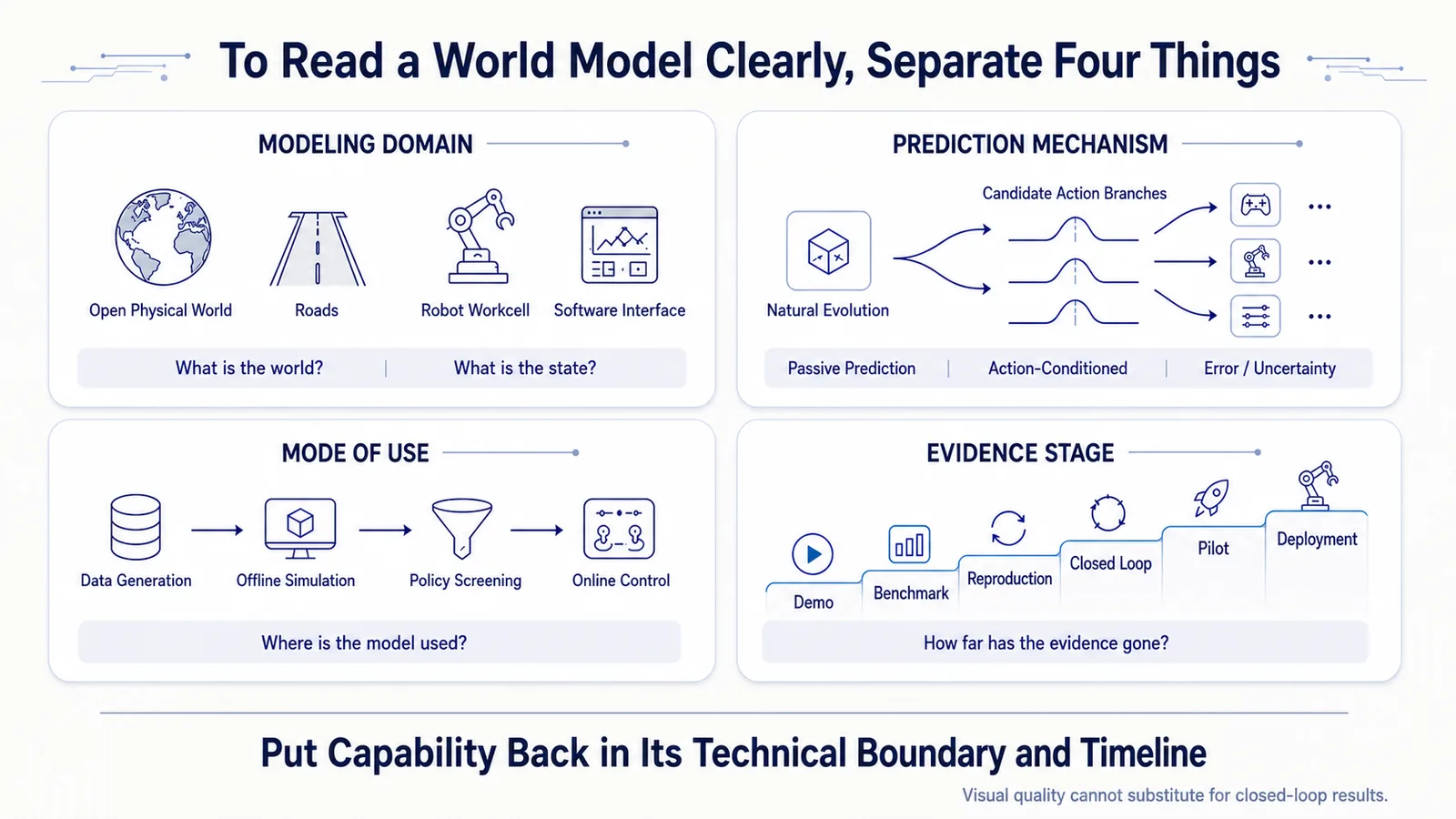
Once the claims are unpacked along these four dimensions, the connections among renderers, simulators, planners, and foundation models remain visible, but their differences are no longer hidden by one large term. An industry can share a long-term direction while preserving the boundaries of its component technologies.
Conclusion: Do Not Flatten the Timeline
The current research and product record suggests that world models may become an important step as AI moves from language to action and from digital environments into the physical world. Video, 3D, robotics, autonomous driving, and software may indeed converge. Some of today’s semantic breadth comes from marketing; some comes from a genuine convergence of technical boundaries.
The most common error in industry communication is to flatten the timeline: “can generate the next frame” becomes “understands the physical world”; “can respond to an action” becomes “can plan”; and “works in a laboratory closed loop” becomes “ready for industrial deployment at scale.”
In 2021, every company wanted to enter the metaverse. In 2026, every model seems to have acquired a world. What the industry lacks is not a larger name, but more rigorous capability labels, more consistent evaluation, and an unedited chain of evidence from model prediction to real-world outcome.
A mature industry does not prove itself by making its conceptual boundary ever larger. It develops a shared vocabulary, repeatable tests, and results that outsiders can verify. Whether world models ultimately become critical infrastructure for the next generation of AI should be answered by those things.
Research note: This essay reflects research completed through August 10, 2026. Funding figures come primarily from company announcements and public reporting and are presented according to their disclosed scope; they do not constitute a complete market estimate. Company-reported benchmarks, customer figures, and deployment data are not equivalent to independent validation. The essay also draws on the author’s earlier research notes, public interviews, and previously published Chinese-language articles. No nonpublic financing or customer information was used.