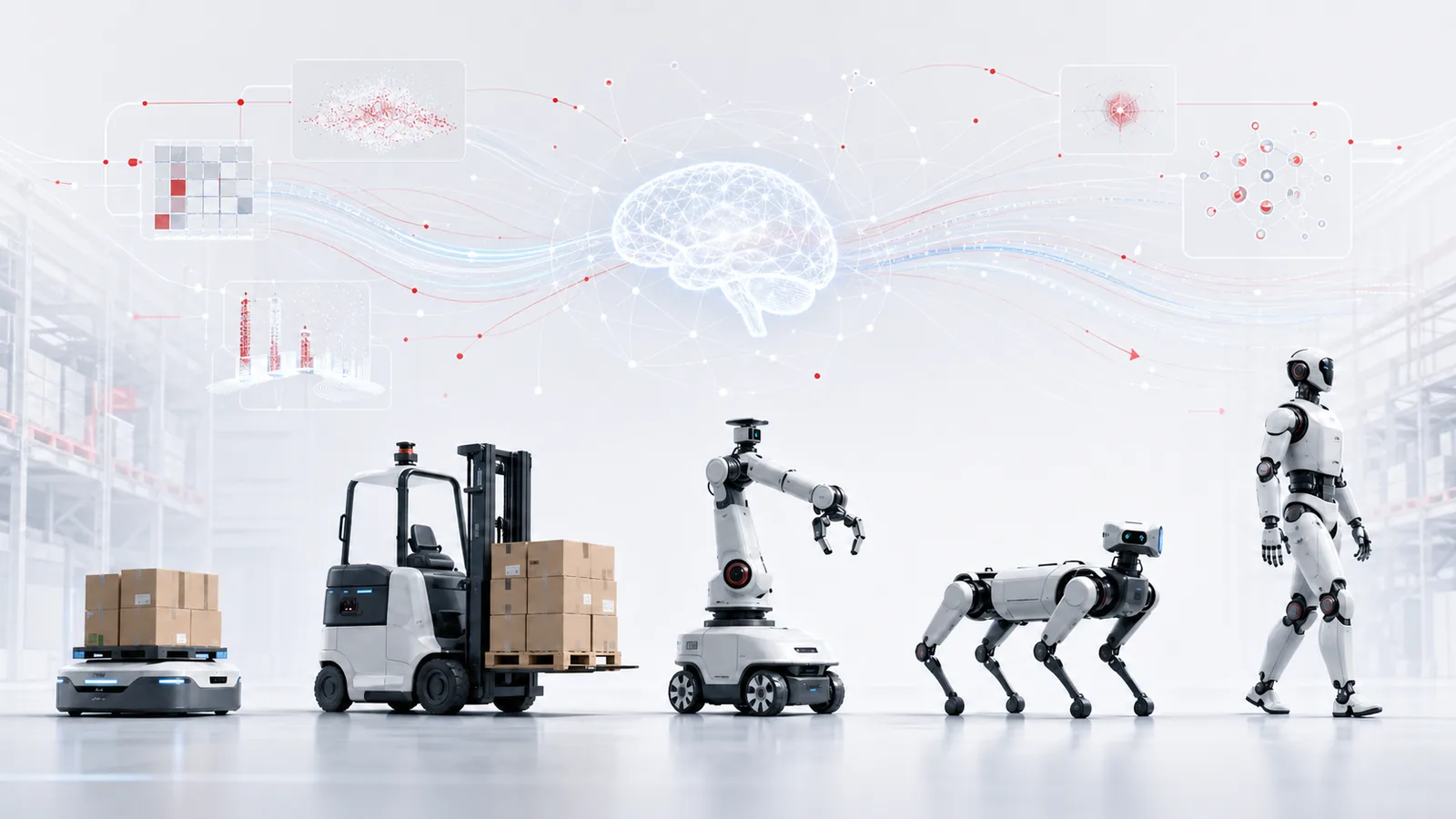
In April 2026, Bessemer Venture Partners published its Robotics and Physical AI report.
It’s worth reading, and not only because BVP is one of Silicon Valley’s most important investment firms. The report doesn’t repackage robotics as “the next AI narrative.” It tries, seriously, to answer a harder and more grounded question:
How far has AI in the physical world actually come?
BVP’s core judgments come down to six:
- Robotics is going through its own “GPT-2.5 moment.”
- Scaling laws are starting to show up in robotics.
- Talent, capital and real data will concentrate rapidly in a small number of companies.
- Near-term value will flow more to vertical full-stack companies than to pure foundation-model companies.
- Defense robotics may be the first segment to produce a mega-cap company.
- The industry as a whole is not necessarily a bubble; it may even still be under-capitalized.
These judgments deserve attention not because they’re new, but because they already overlap to a striking degree with what has actually changed in China’s embodied AI industry over the past two years.
It’s easy to get hooked on a particular demo, a particular model, a particular launch. Stretch the time horizon a little, though, and the real change isn’t there. What matters more is that robotics is gradually entering a pretrained-model phase and a scaling phase. Much of what teams were doing until now was, at bottom, task engineering: patching, tuning and bolting systems together for one setting, one motion, one workflow. What’s changing is that the “brain” itself is getting stronger. Visual representation, world models, policy models, multimodal foundation models — capabilities that used to advance on separate tracks are starting to converge into something that looks a lot more like a foundation-model route.
Put this next to two pieces I wrote earlier and the thread gets clearer. One is the argument in Vision Banana: The T5 Moment for Vision Foundation Models, Not the GPT Moment: vision models are moving from “being able to look at images” to “forming a representation of the world.” The other is what I tried to lay out in The Invariants of Intelligence: any intelligent system, in the end, has to pass through the same layers of attention, representation, learning, prediction and coordination. Robotics just pushes both to the hardest place at once, because a robot doesn’t only have to understand the world. It has to move in it.
So this piece isn’t about the big, empty question of whether robotics is the next hot thing.
I care more about three questions that are narrower and closer to the ground:
- What actually drives scaling in robotics?
- Where are the Chinese path and the American path diverging?
- Over the next year or two, what kind of company can actually take the high ground of the next phase?
Conclusions first
Compressed into a few sentences, my own judgment is:
- Robotics has entered the scaling window, but the more central change is that it’s entering the pretrained-model phase.
- What will ultimately set the industry’s ceiling is not delivery in any single setting, but whether the “brain” can keep evolving.
- Real deployment still matters, but it’s closer to the proving ground where model capability gets tested once it spills over — and the intake for data flowing back — than the only battlefield that matters.
- US–China divergence has begun: the US is more likely to raise the intelligence ceiling first; China is more likely to scale up the engineering first.
In other words, robotics is slowly moving from competing on task engineering to competing on model capability — and from there to a compounding competition in which model capability drives deployment and deployment feeds the model back. That, I think, is the change most worth watching today.
1. The real industrial inflection point is never a single breakthrough
In every major technology wave, the real industrial inflection point is rarely the moment a technology is first invented. The critical moment is usually when it’s first organized stably, engineered, and scaled. That was true of the PC, the internet, the smartphone, large language models, and autonomous driving. The PC’s inflection point wasn’t the birth of the microprocessor; it was chips, operating systems, application software and distribution channels settling into a stable division of labor. The internet’s inflection point wasn’t TCP/IP; it was browsers, servers, search, advertising and payment infrastructure maturing together. The inflection point for LLMs wasn’t the Transformer paper either; it was data, compute, engineering systems, alignment methods and product distribution being recombined by a handful of organizations. Robotics today has arrived at roughly that position. Seen this way, what’s changing in robotics isn’t just “one more model that can walk.” Progress that used to happen separately — in vision foundation models, in world models, in systems engineering — is converging in a single industry for the first time.
Early on, people looked at:
- Can it move
- Can it see
- Can it complete a task
What the next phase actually tests:
- Can it form a stronger representation of the world
- Can model capability transfer to more settings
- Can deployment feed data back into the model
- Can the “brain” itself become more and more of a reusable platform
This is why I think robotics is switching from a demo phase to a systems phase.
2. To understand robotics, first look at where the talent goes
If you want to judge whether an industry is entering a scaling phase, financing is usually a lagging indicator. What’s worth watching is where talent starts to flow. Over the past three years, talent flows in China’s robotics industry have gone through roughly three stages.
Stage one: building the body
Starting in 2023, people from traditional robotics, automation, machine vision, motion control, 3D perception and similar fields began moving into embodied AI.
What this stage solved was, at bottom, the “body problem”:
- The robot body
- Perception
- Control
- Basic hardware capability
Without this layer, all the “intelligence” that comes later is castles in the air.
Stage two: closing the engineering loop
Starting in 2024, senior talent from autonomous driving began flowing systematically into robotics. This shift matters.
What autonomous driving brings isn’t just some algorithm. It’s a complete methodology for handling intelligent systems in the real world:
- Data loops
- Simulation training
- The perception–planning–control pipeline
- Safety redundancy
- Scenario generalization
- Engineering validation
This is precisely why robotics gradually upgraded from a “robotics problem” into a “physical-world AI problem.”
Stage three: adding the foundation model
What’s happening now is the third stage, and the one I think matters most. People from large vision models, large language models, world models and multimodal foundation models are starting to enter robotics — and only when this set of capabilities actually comes in does the industry get a chance to step from task engineering into capability pretraining. Behind this sits a change that’s often underestimated. Robotics used to assume by default that vision was just a perception module, feeding inputs to the control system. But if generative vision backbones really do start learning stronger general-purpose representations, as I argued in Vision Banana: The T5 Moment for Vision Foundation Models, Not the GPT Moment, then the role of vision inside a robot changes.
It’s no longer just “what did I see.” It’s closer to answering “how can this world be stably represented internally.” And once the representation changes, the learning, prediction and motion planning downstream all change with it.
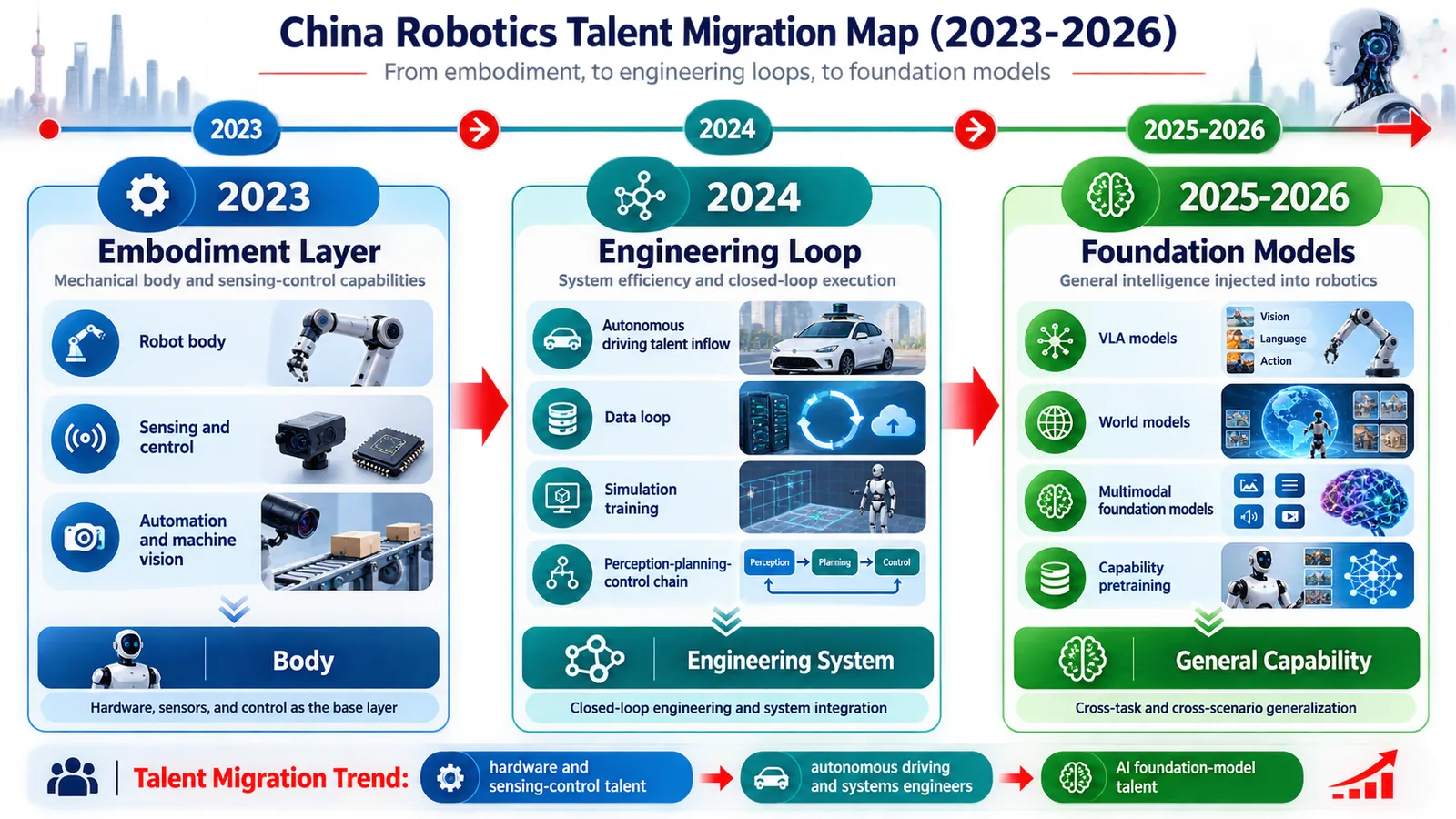
Compressed into one line:
2023: the body. 2024: the engineering loop. 2025–2026: the foundation model.
Only when these three capabilities genuinely converge does robotics have the conditions to scale in the full sense of the word.
3. Why scaling robotics is harder than scaling LLMs
Robotics will of course borrow from the LLM playbook. But anyone expecting a straight replay of that path is probably going to be wrong. The reason isn’t complicated. The core object of LLM scaling is digital tokens; the core object of robotics scaling is states, actions, constraints and feedback in the physical world. That produces four very practical structural differences. In the framework of The Invariants of Intelligence, robotics is harder than LLMs not just because it adds hardware, but because it has to drag attention, representation, learning, prediction and coordination into the real world for verification almost simultaneously. A language model can often create enormous value simply by doing well enough in symbolic space. A robot can’t. Every one of its layers has to take immediate feedback from the physical world.
1. Data is more expensive
Text, images and code can be pulled from the internet at scale.
Robot data can usually come only from:
- Real hardware
- Simulation environments
- Teleoperation
- Human demonstration
- Field deployment
So behind every high-quality piece of robot data sits a hardware cost, a scenario cost, a time cost and a safety cost.
2. Feedback is slower
When a language model gets something wrong, it can usually be corrected quickly through user feedback, preference data or evaluation sets.
When a robot gets an action wrong, it can mean damaged equipment, a failed task, or a safety incident.
Put bluntly, the physical world has no environment naturally suited to low-cost trial and error.
3. Generalization is harder
The same sentence means the same thing on every screen.
The same grasping task, under different lighting, materials, angles, friction coefficients and occlusion, can produce completely different results.
Robots operate in a continuous state space and a high-dimensional action space, so the long tail is far more complex than in any pure software system.
4. More system constraints
A robot isn’t a model plus an API.
It’s a complete system:
- Robot body
- Joints
- Motors
- Reducers
- Sensors
- Batteries
- Controllers
- Cloud training
- Edge inference
- Fleet scheduling
- After-sales operations and maintenance
If any one link fails, the whole system’s capability never gets delivered.
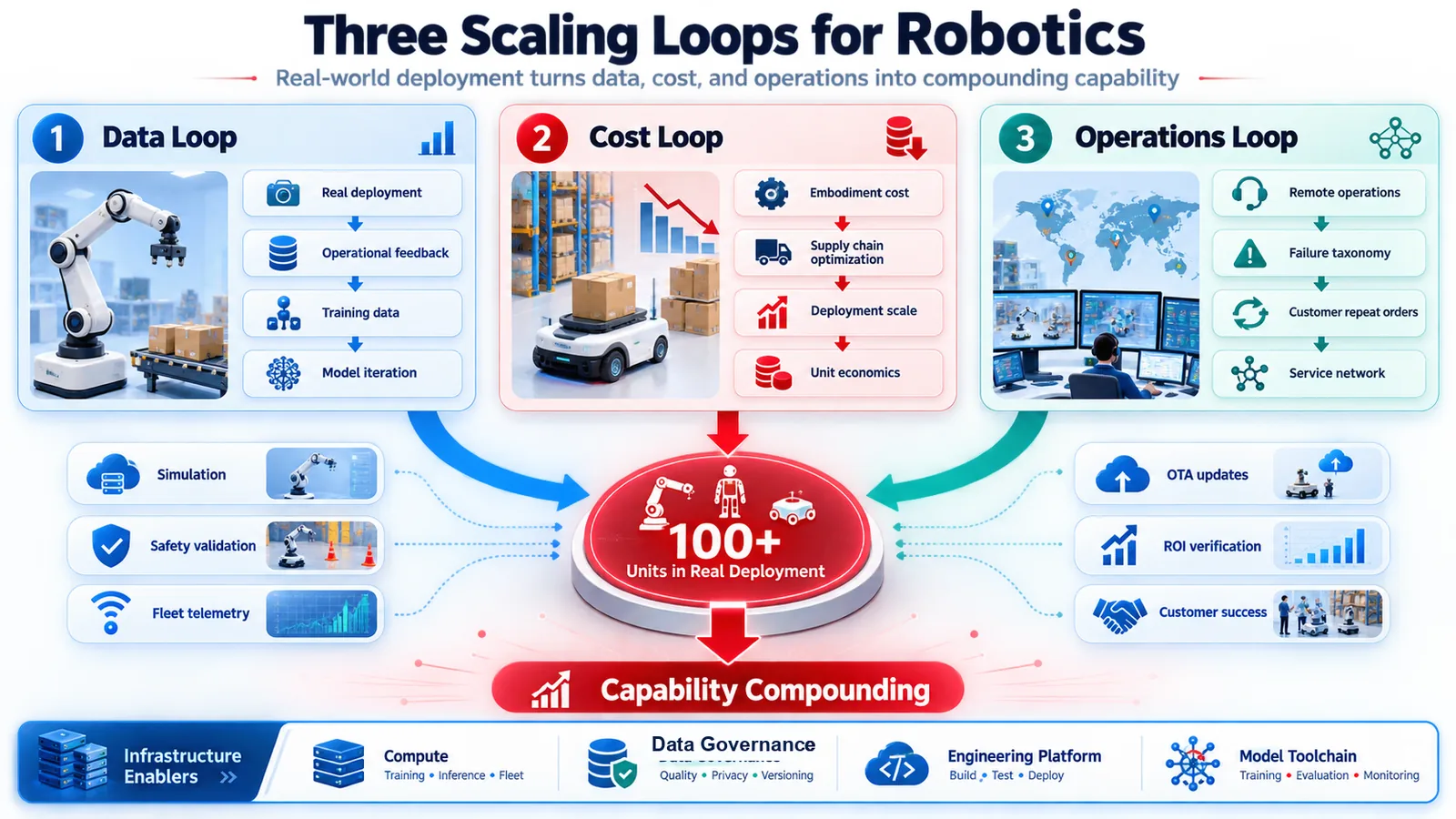
So what robotics actually has to get working is three interlocking closed loops:
- The data loop
- The cost loop
- The operations loop
Lose any one of them and it’s hard to go further.
4. The real battlefield: how the brain unlocks the deployment flywheel
Looking out one to two years, what I care about most isn’t just deployment counts. It’s whether robotics will genuinely produce a group of companies that start to carry the DNA of a pretrained-model company. Put differently, whether competition shifts from “who can get one task working end to end” to “who builds strong general-purpose brain capability first.”
The brain here isn’t an abstraction. It’s a synthesis of several capabilities:
- More stable visual representation
- Stronger world models
- More transferable policy models
- Longer-horizon task understanding and execution
- Transferring what was learned in one setting to another at lower cost
If this layer of capability really starts to rise, it brings a change more important than any single-point deployment:
Model capability first unlocks applications; applications then become fleet deployment; fleet deployment then sends data back to the model.
That is the flywheel in robotics actually worth looking forward to.
So real deployment matters, of course, but it’s a middle link rather than the whole answer. Deployment means three things:
- It verifies whether model capability can actually punch through real-world constraints
- It exposes long-tail problems and tells the model what it still lacks
- It feeds real-world data back into the training system for the next round of improvement
From this angle, I’ll still look at deployment, but I won’t treat it as the end in itself. I’d rather read it as a middle node in a flywheel. Written in its simplest form, the flywheel is:
Model capability unlocks applications, applications bring deployment, deployment brings data, and data in turn strengthens the model.
Without the model capability up front, most of the deployment that follows is a local optimum brute-forced by engineering. Without the deployment flowing back at the end, the model capability up front easily stalls in the lab. Neither side can be missing — but what sets the long-term ceiling is still the brain.
5. The Chinese and American paths have started to diverge
Put China and the US side by side and you can already see two rather different paths.
The US: betting on the intelligence ceiling
The American path is closer to an extension of the LLM industry. For Figure, Skild AI, Physical Intelligence, Apptronik, Agility Robotics, Tesla Optimus and their peers, the core narrative concentrates on:
- General-purpose intelligence
- Robot foundation models
- VLA (vision-language-action) models
- World models
- High-value industrial settings
America’s advantages lie mainly in:
- Foundation models
- Top talent
- Venture capital
- High-value settings such as defense, warehousing and manufacturing
China: betting on engineering scale
The Chinese path is closer to a spillover of “EVs + industrial automation + supply-chain engineering.” China’s advantages are very concrete:
- The world’s largest set of manufacturing settings
- The most complete hardware supply chain
- The fastest ability to drive costs down
- Denser real-world application environments
China isn’t building humanoid robots from zero; it’s evolving forward on top of automation, components, complete-robot manufacturing and field validation. This is easily misread as a pessimistic take on Chinese robotics, and I mean the opposite. I don’t think China can only do engineering and not the brain. What I want to stress is that model capability sets the ceiling, but whoever plugs model capability into real settings faster — and feeds the data back into the model — has the better chance of continuously closing in on that ceiling. And that is precisely the thing about China not to underestimate.
We’ve seen a similar path once already, in autonomous driving and EVs. At first many people assumed the real contest would be decided on single-point technology. Over time it became clear that what actually shaped the industry wasn’t whether a given algorithm was a generation ahead, but who could compress algorithms, supply chain, manufacturing, field validation and cost reduction into one continuously running system faster. LLMs have a similar side. The ceiling is of course set by foundation-model capability, but what turns capability into industrial advantage is rarely the model sitting in the lab; it’s whoever closes the loop among product distribution, user interaction, application data and model iteration faster. Robotics will most likely follow the same logic. Seen this way, China’s advantage isn’t simply “cheap manufacturing” or “a complete supply chain.” More importantly, China has the chance to build the full closed loop faster:
- Models entering the field
- The field turning into deployment
- Deployment generating data
- Data feeding the model
- Model upgrades driving the next iteration of hardware and systems
Look one layer deeper and this divergence isn’t only a difference in capital and industrial structure. The US finds it easier to raise the ceiling first at the representation and prediction layers, because foundation models, vision models, world models and top research talent are more concentrated there. China finds it easier to build an advantage first at the coordination and scale-amplification layers, because its manufacturing settings, supply-chain density and real-world operating environments are more complete. So this isn’t a simple question of who’s stronger. It’s more like the same intelligent system pulling ahead at different layers in different places.
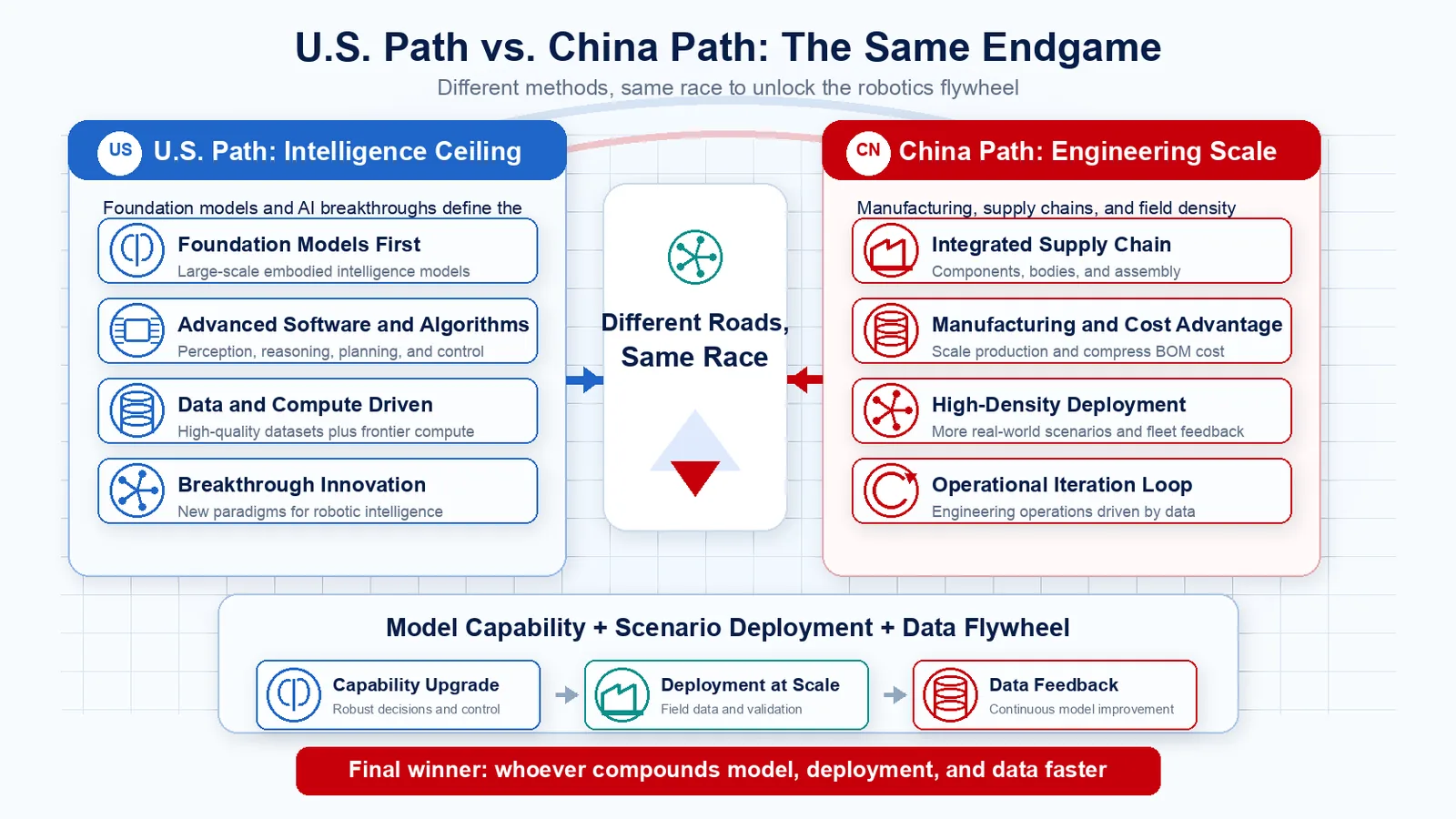
Over the next few years, then, a fairly clear structural divergence is likely to emerge:
- The US is more likely to define the ceiling of robot intelligence first
- China is more likely to produce hardware scale, the cost curve and scenario density first
The eventual winners won’t necessarily stand on one side alone. They’re more likely to be the companies that connect model capability, engineering capability and commercial deployment at the same time. But if I had to name the layer that decides everything, I’d still vote for the brain. Engineering scale can amplify an advantage; only brain capability truly sets the ceiling.
That doesn’t make me more pessimistic about the future of Chinese robotics. Quite the opposite — it makes me more confident. Once model capability genuinely becomes the main axis of robot competition, China is very likely to be one of the first places in the world to compress “model capability – application – data flowing back – hardware iteration” into an industrial flywheel. In other words, the US may find it easier to pull the ceiling up first, but China has every chance to turn that ceiling into scaled capability faster, and then feed scaled capability back into the model. If that chain gets working, what Chinese robotics ends up with isn’t just a manufacturing advantage. It’s the ability to keep amplifying a model advantage.
6. What to actually look at when investing in robotics
A very common misjudgment in robotics is to equate an advanced form factor with an advanced business. Humanoids have the most narrative pull and soak up the most attention, but they won’t necessarily be the first to produce the largest commercial value.
In the near term, the more certain opportunities are still likelier to come from settings with clearer ROI and more controllable environments:
- Manufacturing
- Warehousing and logistics
- Cleaning
- Healthcare
- Inspection
- Agriculture
- Defense
So when you judge a robotics company, you really can’t judge it by the keynote. You have to go back to a few plainer but more useful criteria. The one thing I’d change is the order: I’d put “is model capability beginning to enter the pretraining and scaling phase” closer to the top.
1. Is the brain actually getting stronger
This includes:
- Is representation capability upgrading
- Are world models starting to become usable
- Are policy models starting to show transferability
- Is multimodal understanding starting to enter real task chains
If nothing changes at this layer, most deployments end up as customized engineering.
2. Real deployment and the ability to feed data back
I’ll still look at deployment, but the focus shifts: does deployment feed the model, rather than whether the deployment numbers look pretty. What really matters is whether field data settles into the next round of model improvement.
3. Task success rate and recovery
An 80% success rate gets you a demo.
99% might get you into limited commercial use.
99.9% is what it takes to enter critical production steps.
4. The cost-down curve
Without BOM reductions and supply-chain optimization, deployment at scale can’t be sustained.
5. Customer repurchase and order quality
Strategic partnerships, pilot orders and genuine repeat purchases are very different things. Only the last one really matters.
6. Systematic operations capability
Once robots reach deployments at the hundred-unit scale, the company has to upgrade from “project delivery” to “continuous operations.”
Remote diagnostics, OTA updates, spare-parts response, failure prediction, on-site training and SLAs all become part of competitiveness.
7. Organizational metabolic rate
Looking further ahead, I’ll still watch something more fundamental: organizational metabolic rate, because what robotics companies ultimately compete on is whether they can quickly convert field feedback into model iteration, product fixes, supply-chain adjustments and customer delivery. In the end, this round of robotics investing isn’t necessarily about backing the companies that look most like robots.
It’s about backing:
The companies that look most like foundation-model companies, and can at the same time plug model capability into the real world.
Because from a more fundamental vantage point, what robotics companies ultimately compete on isn’t a single-point model, nor a single-point body, but who can stably compress the whole chain — attention, representation, learning, prediction, coordination — into a system that keeps strengthening itself.
One last judgment
Robotics has indeed entered the scaling window, but there’s clearly still a distance to go before general-purpose intelligence actually starts paying off. The most critical question now isn’t just “will robots become the next big platform.” It’s:
Which companies can first bring robotics genuinely into the pretrained-model phase, and connect model capability, applications and data flowing back into a flywheel.
Over the next 2–3 years, I think robotics will most likely show two phenomena at once:
- On one side, capital keeps pouring in, valuations keep rising, and technology narratives keep expanding
- On the other, companies with homogeneous hardware, low-quality orders and no data loop are washed out, step by step
The sector as a whole may not be a bubble, but local bubbles are almost unavoidable. The companies that finally break through won’t simply be those with the best hardware, the best model or the most funding. They’ll be the ones that get brain capability, real settings, data flowing back and organizational metabolism compounding together earliest. So the real inflection point for robotics isn’t the first time a machine looks like a human, nor even the first time machines are deployed at scale. It’s the first time a machine has a “brain” that can keep evolving and keep unlocking new applications. Connect this essay with the earlier discussions of vision foundation models and the invariants of intelligence, and they land on the same judgment:
The next phase of AI is no longer just “can it speak,” “can it write,” “can it generate.” It’s whether it can form a stable representation of the world, keep learning under constraints, and turn single-point capability into systemic compounding.
Robotics matters precisely because it puts all of these questions on the table at once.
Further reading
If you want a fuller view of the methodology behind this essay, continue with my two earlier pieces:
-
Vision Banana: The T5 Moment for Vision Foundation Models, Not the GPT Moment This one focuses on why visual representation is once again becoming the core of foundation-model competition.
-
The Invariants of Intelligence This one is more of an overall framework: why attention, representation, learning, prediction and coordination are the underlying structure no intelligent system can get around.